Optice · 1706
First Latin edition
The Question
What is light?
Grimaldi had shown that light behaved in ways that geometrical optics could not fully explain. Newton pursued a more fundamental question: what was light itself?
Through experiments with prisms, colour, reflection and refraction, Opticks transformed the investigation of light. Its conclusions would dominate eighteenth-century optics and provide the starting point for debates that eventually led to wave theory, electromagnetism and quantum physics.
Why This Work Matters
First published in English in 1704 and translated into Latin in 1706, Opticks stands alongside the Principia as one of Newton’s major scientific works.
Newton demonstrated that white light is not elementary but composed of rays associated with different colours. His prism experiments showed that these colours were properties of the light itself rather than modifications produced by the prism.
He also investigated reflection, refraction, interference-like phenomena and the colours produced by thin films, while developing a predominantly corpuscular account of light. Newton’s authority ensured that this conception profoundly shaped optical science throughout the eighteenth century.
Yet Opticks was important for more than its conclusions. Its carefully staged experiments provided an influential model for investigating nature through the controlled interaction of observation, experiment and reasoning.
Later generations would overturn important parts of Newton’s interpretation while continuing to confront the phenomena and questions that Opticks had placed at the centre of the science of light.
Place in the History of Ideas
Foundations
By the late seventeenth century, optics had become both a mathematical and experimental science.
Euclid, Ibn al-Haytham, Kepler and Maurolico had developed increasingly sophisticated accounts of vision, reflection and refraction. Grimaldi’s experiments had revealed diffraction, demonstrating that light could behave in ways simple geometrical models could not adequately describe.
The question was becoming more fundamental:
What was light itself?
This Work
Isaac Newton · Opticks · 1704
Newton approached the problem through an extraordinary programme of experiment.
His prism experiments demonstrated that white light could be separated into a spectrum of colours and recombined into white light. Colour, Newton argued, was therefore not created by the prism: white light was itself heterogeneous.
Newton developed a largely corpuscular conception in which light consisted of minute particles. Although this interpretation would eventually be displaced by wave theory, it became the dominant framework for eighteenth-century optical science.
Opticks also extended far beyond a single theory. Its experiments and famous Queries opened questions about light, matter and the forces of nature that would occupy later generations.
Immediate Legacy
Newton’s work became a principal reference point for eighteenth-century optics.
Lambert helped transform the measurement of light into a quantitative science. At the beginning of the nineteenth century, Young’s interference experiments revived the case for wave behaviour.
Fresnel subsequently provided the mathematical framework through which interference and diffraction could be explained by wave theory, overturning the Newtonian corpuscular account that had dominated for generations.
Long-Term Influence
The eventual displacement of Newton’s corpuscular theory did not diminish the importance of Opticks.
Maxwell’s electromagnetic theory ultimately identified light with electromagnetic waves, while Hertz provided experimental confirmation of electromagnetic radiation.
Quantum physics then complicated the distinction between wave and particle descriptions altogether. Einstein’s light quantum introduced a radically different form of quantisation, beginning another transformation in the understanding of light.
Across these changes, many of the fundamental questions remained recognisably Newtonian: what is light, how does it interact with matter, and what can experiment reveal about its underlying nature?
The Conversation
INHERITED
Euclid · Ibn al-Haytham · Kepler · Maurolico · Grimaldi
Geometry and experiment had revealed increasingly complex properties of light, but its physical nature remained unresolved.
NEWTON · 1704
Prism experiments revealed white light as a mixture of colours and placed the physical nature of light at the centre of optical science.
PASSED ON
Lambert · Young · Fresnel · Maxwell · Hertz · Einstein
Newton’s answers would be challenged, but the questions posed by Opticks continued to shape the investigation of light for more than two centuries.
LUMEN Insight
The most influential scientific works retain their importance even when their theories are overturned.
Newton’s corpuscular account of light would eventually give way to wave optics, yet Opticks continued to shape the questions, experiments and language of the field. Its history illustrates how science advances not simply by preserving correct answers, but by testing, challenging and transforming powerful explanations.
Why this Copy Matters
LUMEN holds two complementary early editions of Newton’s Opticks, documenting the transmission of Newtonian optical science across languages, countries and generations.
The principal volume is the first Latin edition of 1706, translated by Samuel Clarke only two years after the English first edition. Newton revised the work for this edition and added seven new Queries, while the volume also contains two mathematical treatises, including the first published account of his method of fluxions.
Alongside it is the first French edition of 1720, a copy bearing the ownership stamp of the eminent French chemist Nicolas Lémery. Here the association is much closer to the original period of publication, connecting Newton’s optical ideas with the scientific culture of early eighteenth-century Europe.
Together, the two volumes document more than the publication history of Opticks. They show a scientific work moving between languages, countries, institutions and individual readers.
The Copy
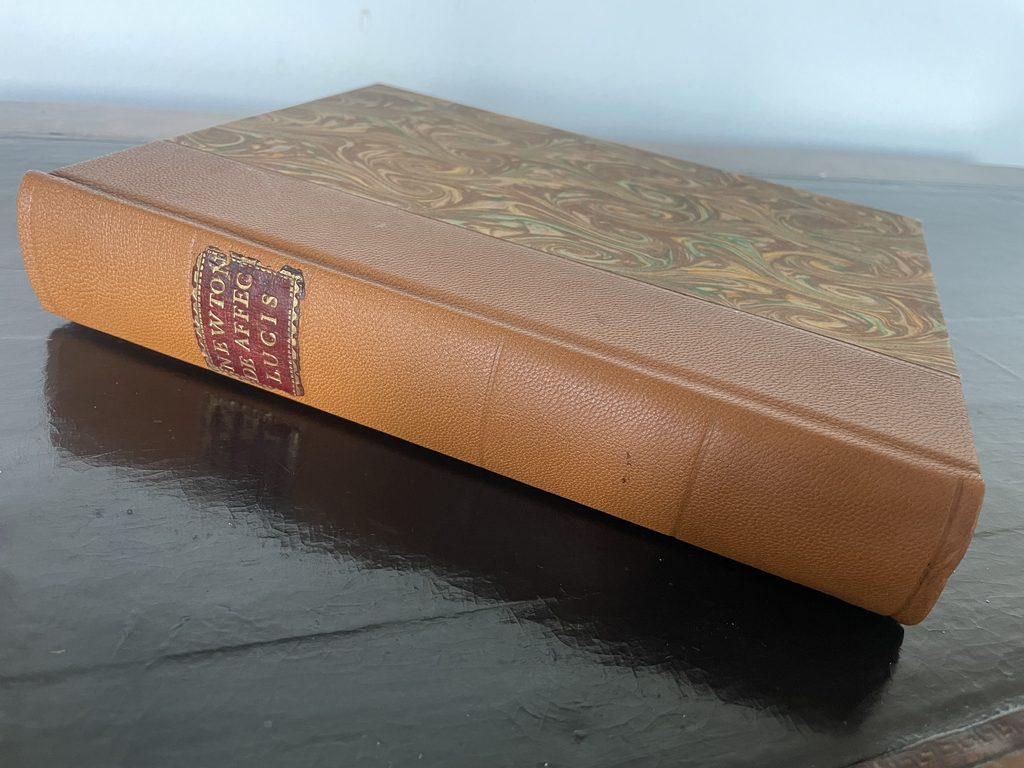
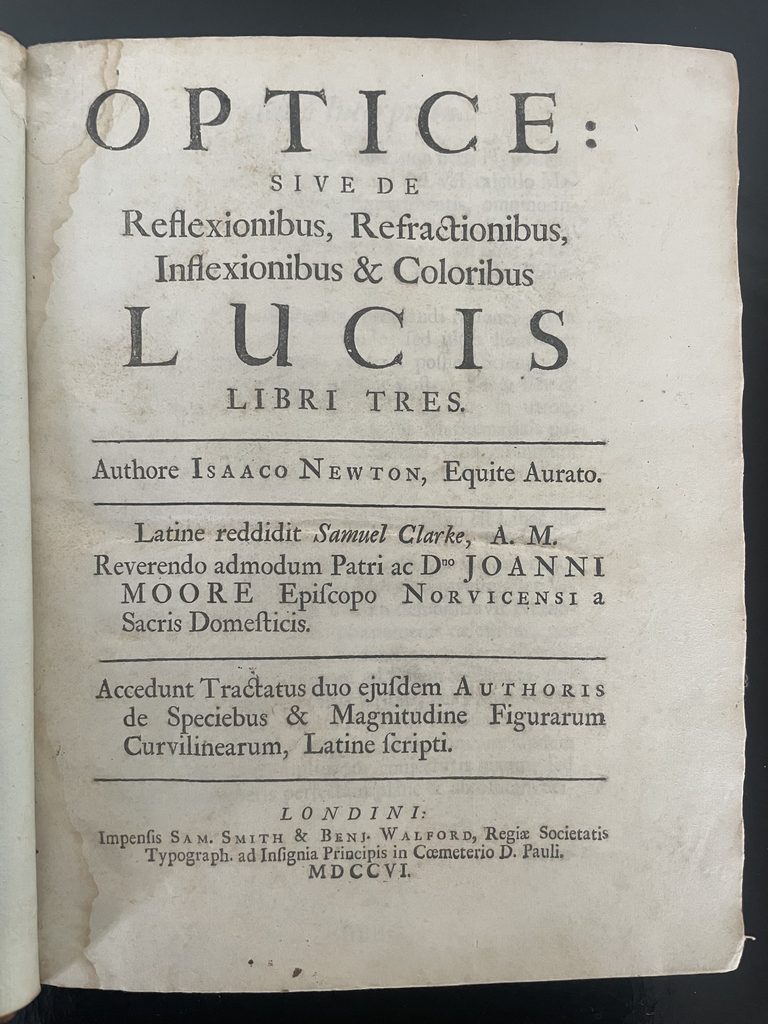
First Latin edition. London: Samuel Smith & Benjamin Walford, 1706. Quarto.
Newton’s Opticks first appeared in English in 1704. This Latin translation by Samuel Clarke, published two years later, made the work accessible to the international scholarly community for which Latin remained a common intellectual language.
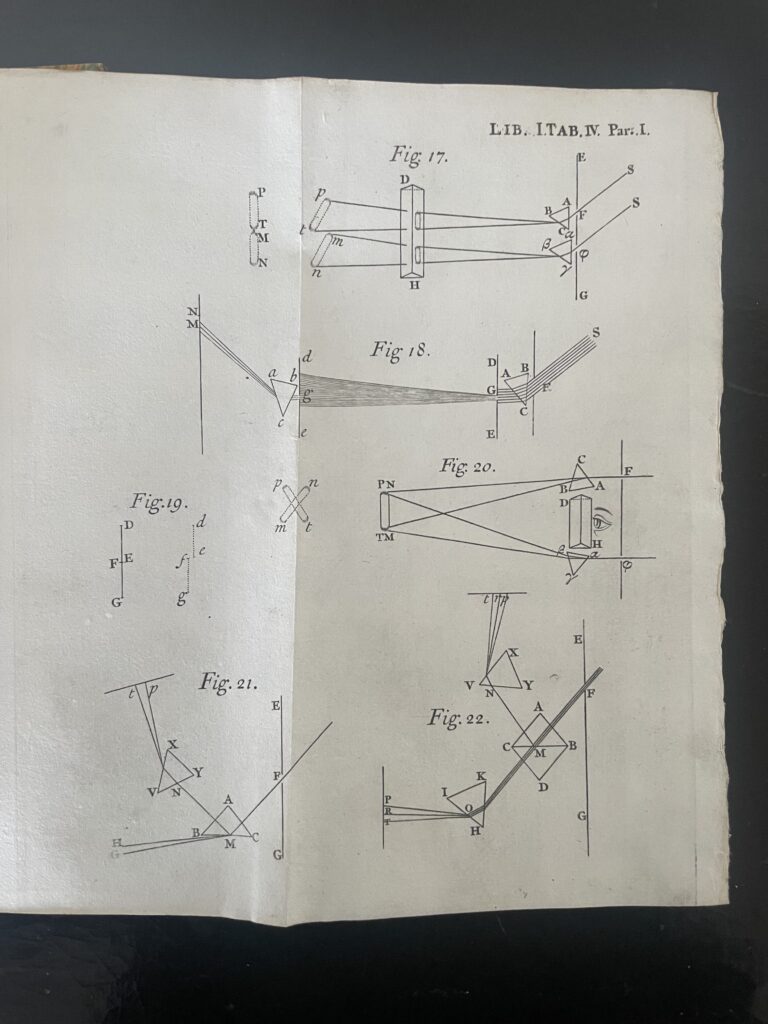
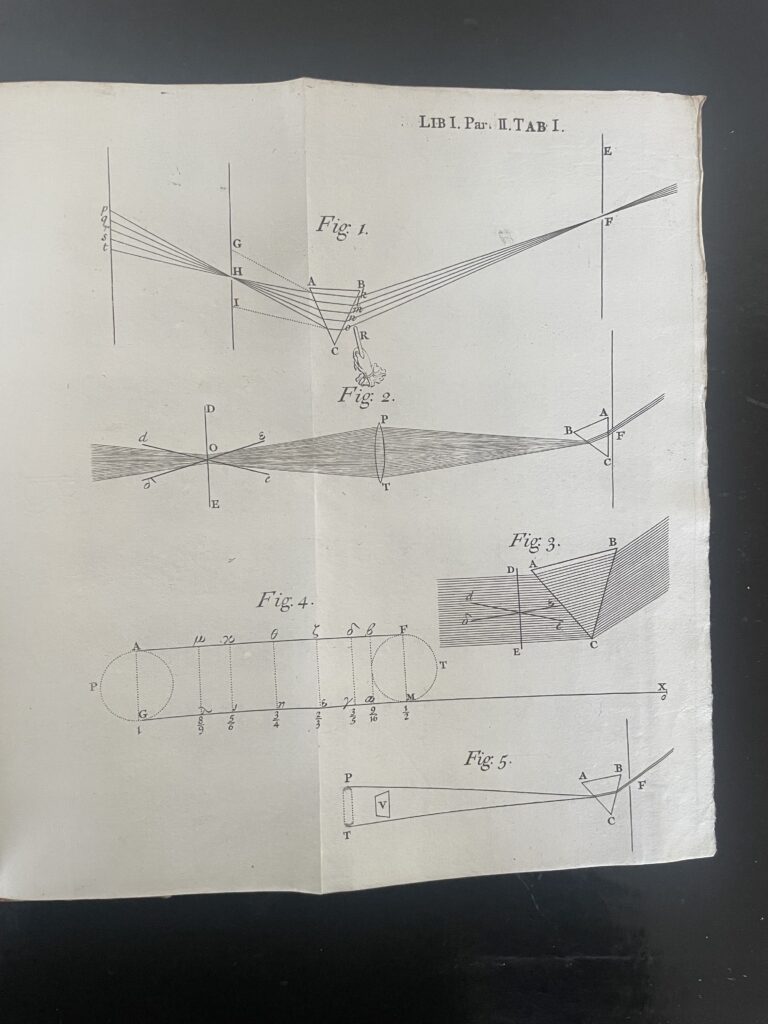
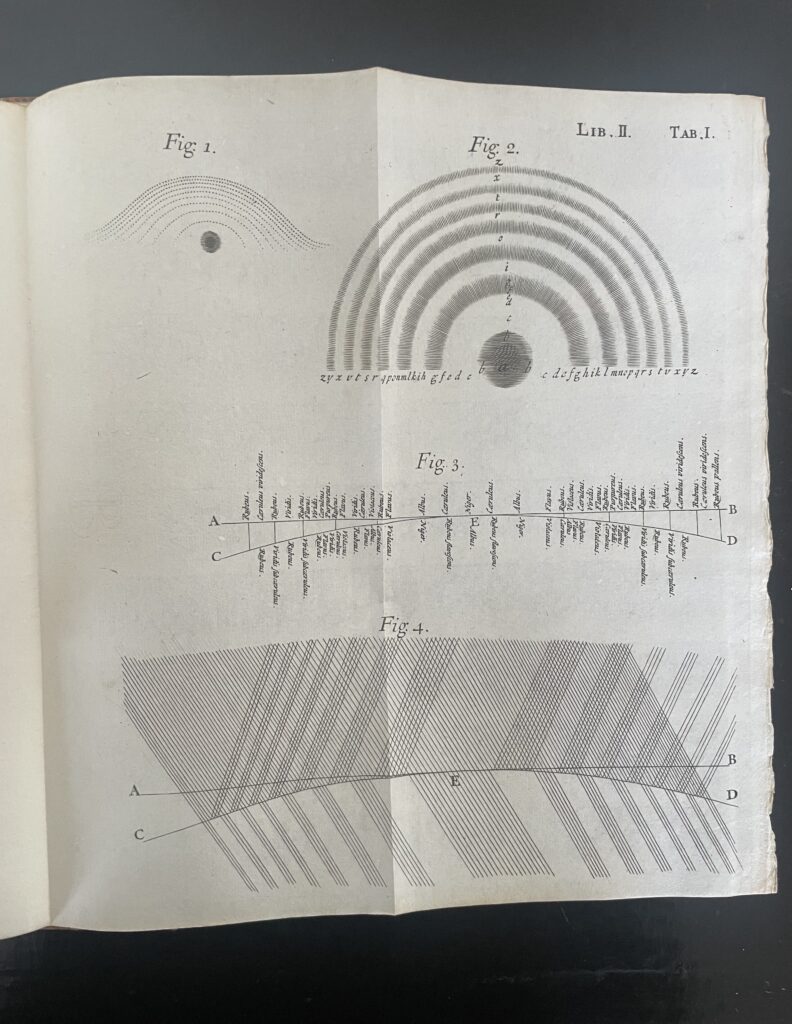
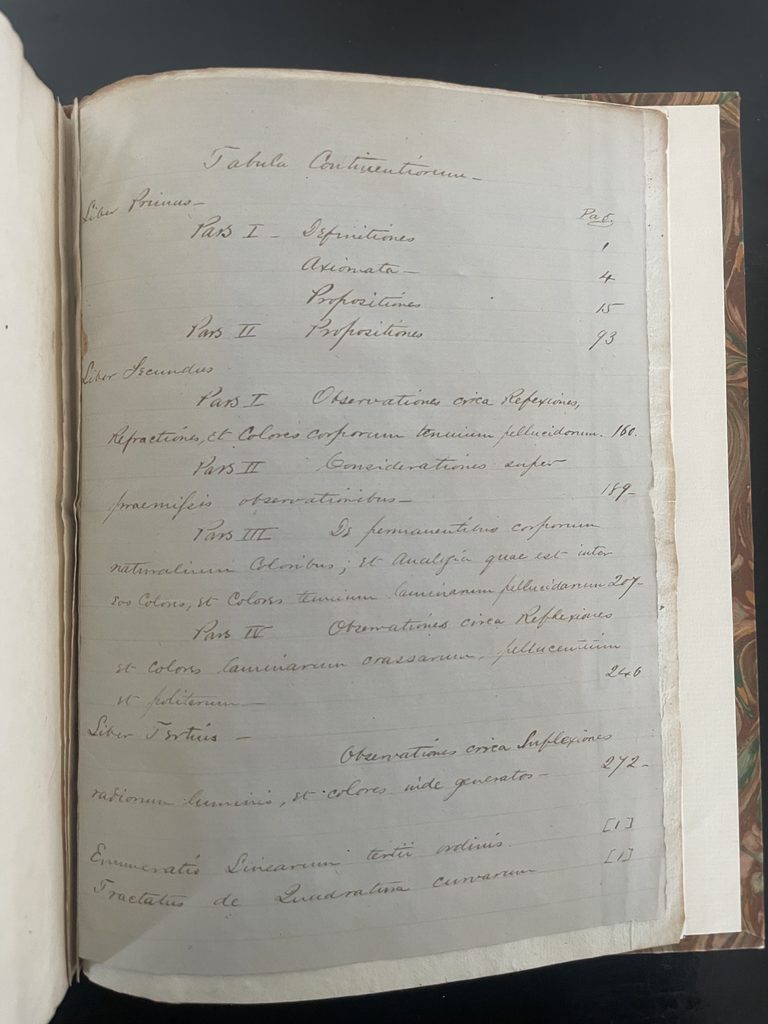
The volume contains nineteen folding engraved plates illustrating Newton’s optical investigations. A nineteenth-century manuscript leaf entitled Tabula Continuatiorum was later tipped in at the end, providing physical evidence of the book’s continued use long after its publication
The present binding is modern morocco-backed boards, but preserves the earlier red morocco spine label.
A Life in Science
Albert Hopkins
Professor and scientific educator
↓
Elizabeth K. Hopkins
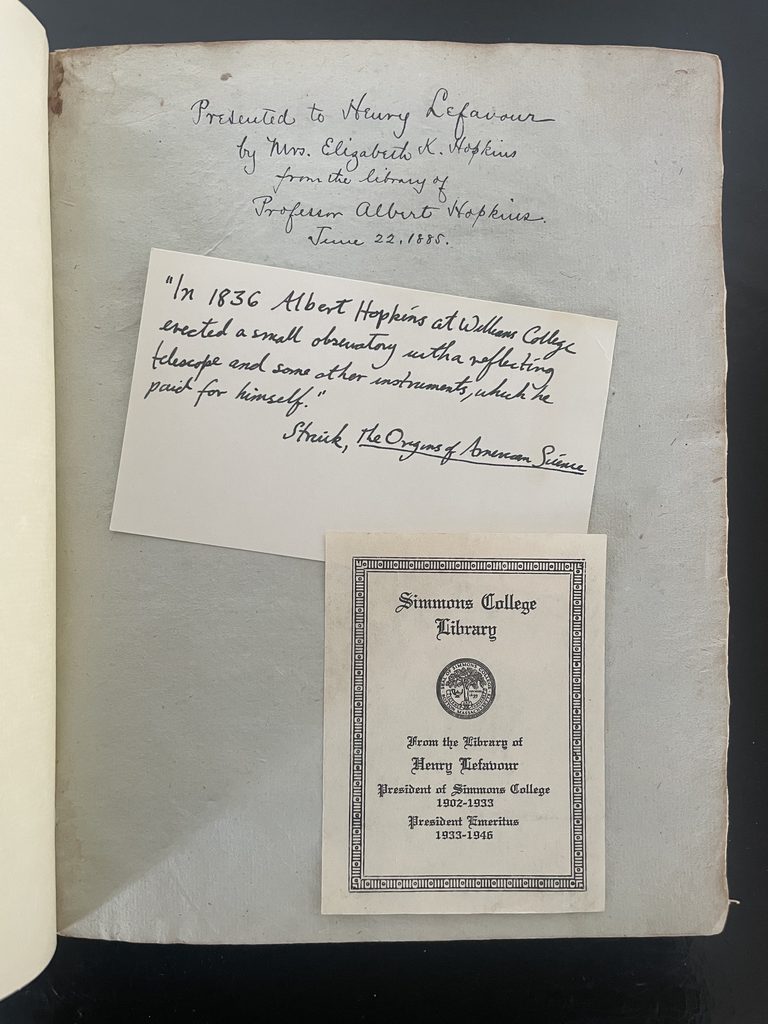
Presented the volume from Professor Hopkins’s library, 22 June 1885
↓
Henry Lefavour
Physicist, educator and later President of Simmons College
↓
Simmons College
Bookplate recording the Library of Henry Lefavour
↓
The LUMEN Library
The preserved front endpaper records the transfer directly:
“Presented to Henry Lefavour by Mrs. Elizabeth K. Hopkins from the library of Professor Albert Hopkins. June 22, 1885.”
That inscription gives this copy a particularly tangible history of transmission. More than a century after Newton, the book remained within the world of scientific education, passing from one academic library to another before entering an institutional collection.
More Than Optice
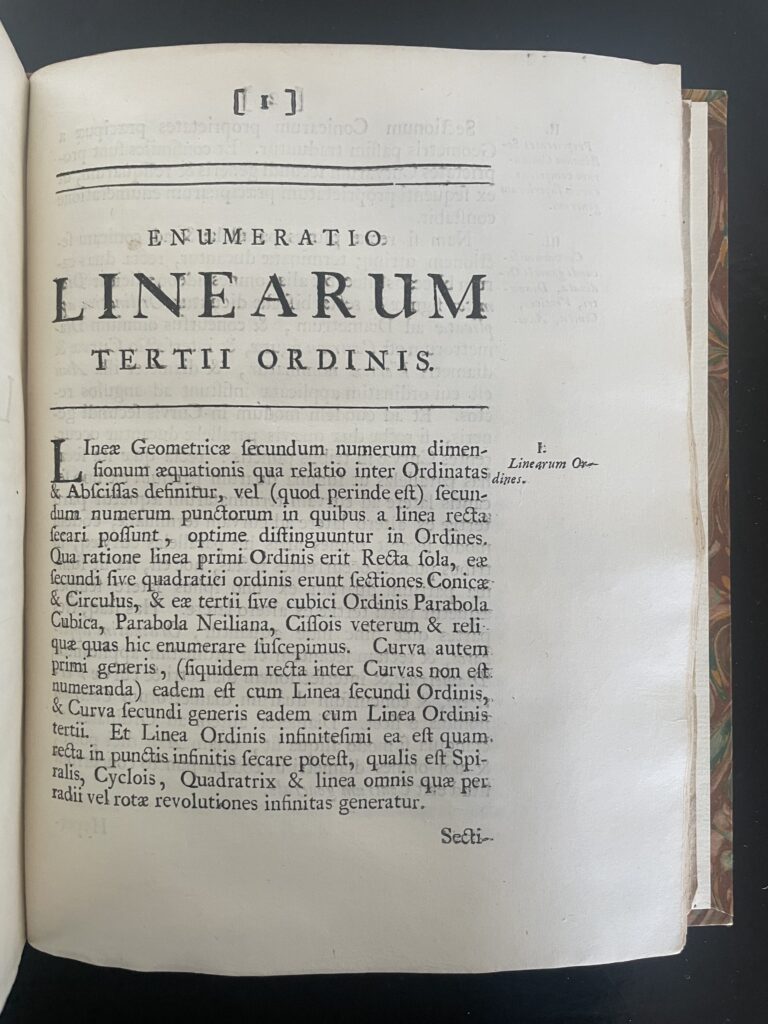
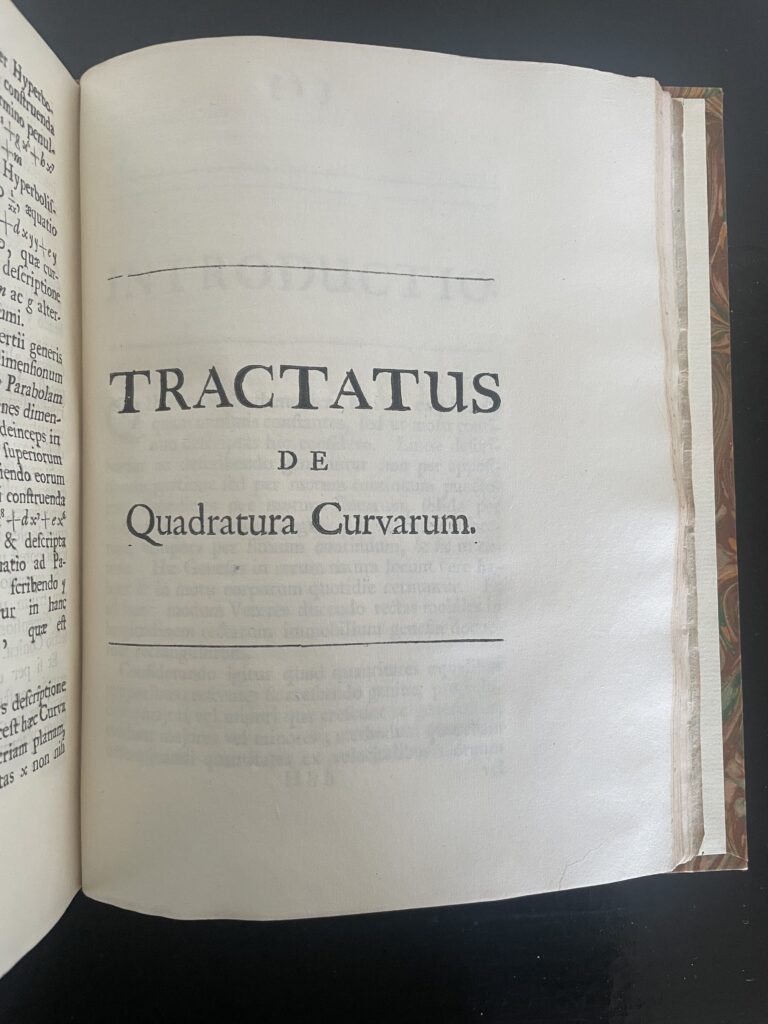
The 1706 volume contains more than Newton’s Optice. Appended to the work are two mathematical treatises by Newton: Enumeratio linearum tertii ordinis, concerned with the classification of cubic curves, and De quadratura curvarum, dealing with the quadrature of curves.
The latter has particular historical significance. It contains Newton’s first published account of his method of fluxions, the mathematical technique that formed his approach to calculus.
Their presence gives the volume an unusual breadth. A book principally associated with Newton’s investigation of light also preserves important evidence of his work in pure mathematics, connecting this LUMEN object with another of the great transformations of seventeenth-century science.
LUMEN Connection
The Language of Mathematics → Fluxions, curves and the development of calculus
Across Europe
First French Edition · 1720
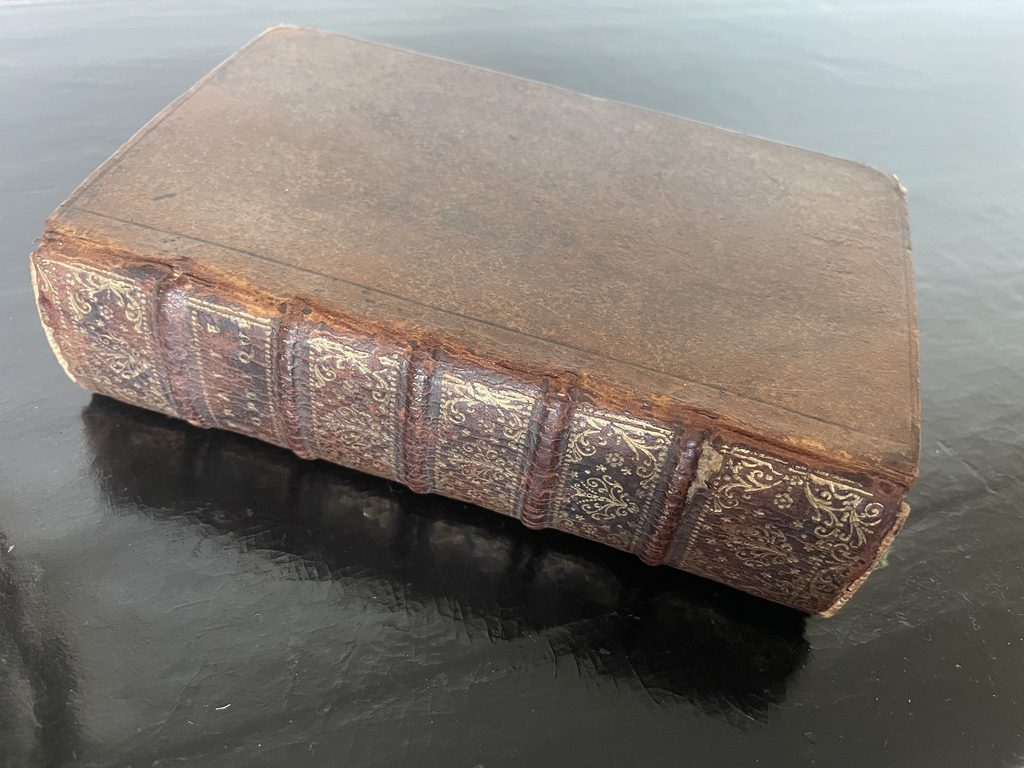
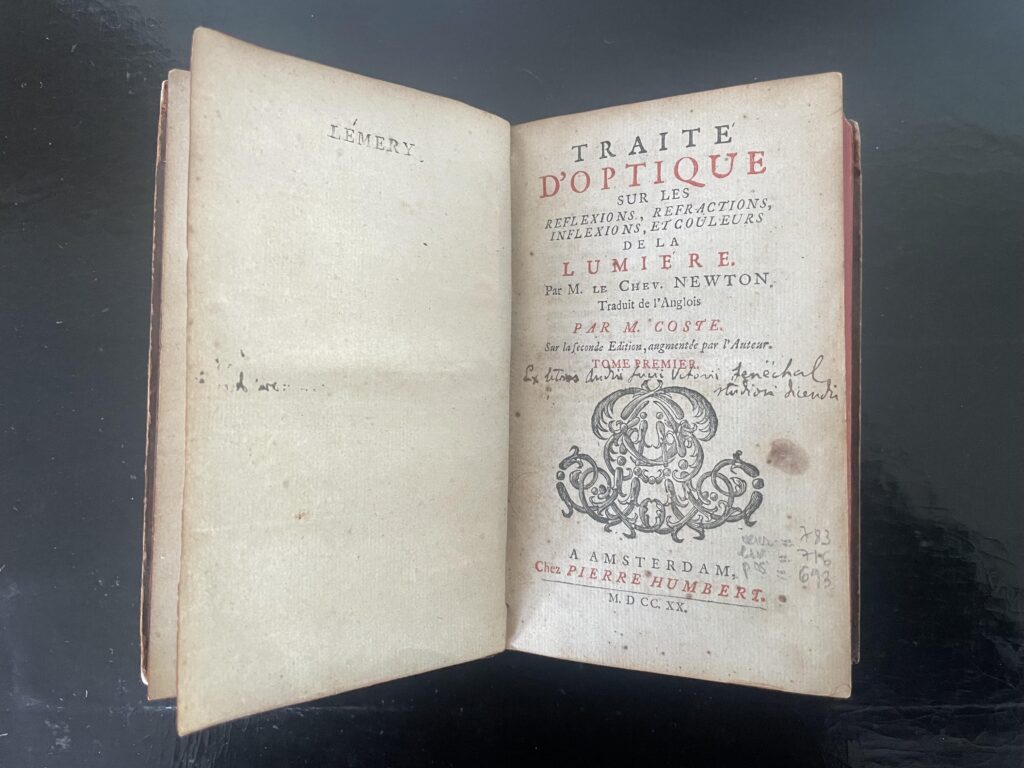
Amsterdam: Pierre Humbert, 1720. First French edition.
The French translation represents another stage in the movement of Newton’s ideas across Europe. Published sixteen years after the English Opticks, it brought Newton’s investigations of light, colour, refraction and diffraction directly into the French-speaking scientific world.
LUMEN’s copy bears the ownership stamp “Lemery”, associating it with the eminent French chemist Nicolas Lémery. This contemporary scientific provenance gives the volume particular significance: Newton’s optical work was not simply being translated for a new audience, but circulating within the intellectual world of early eighteenth-century natural philosophy.
The two LUMEN volumes therefore preserve two different forms of transmission:
English Opticks · 1704
↓
Latin Optice · 1706
International scholarly transmission
↓
French Traité d’optique · 1720
Transmission into the French scientific world
Bibliographical Details
First Latin Edition · 1706
NEWTON, Sir Isaac.
Optice sive de Reflexionibus, Refractionibus, Inflexionibus, et Coloribus Lucis libris tres.
London: Samuel Smith & Benjamin Walford, 1706.
Edition: First Latin edition
Translator: Samuel Clarke
Format: 4to
Illustration: 19 folding engraved plates
Contents: Optice, followed by Newton’s two mathematical treatises, Enumeratio linearum tertii ordinis and De quadratura curvarum
Binding: Modern morocco-backed boards, preserving earlier red morocco spine label
Condition: Good; occasional soiling or very slight browning; damp-staining to inner margin of first few leaves and very small repair at head of gutter
Copy Notes: Nineteenth-century manuscript Tabula Continuatiorum tipped in at end; numerical ink stamp to lower margin of A2
Provenance: Professor Albert Hopkins; presented by Elizabeth K. Hopkins to Henry Lefavour, 22 June 1885; Simmons College, Library of Henry Lefavour
References: Babson 137; ESTC T149601
First French Edition · 1720
NEWTON, Isaac.
Traité d’optique sur les réflexions, réfractions, inflexions et les couleurs de la lumière.
Amsterdam: Pierre Humbert, 1720.
Edition: First French edition
Format: 12mo
Pagination: xv, [1 blank], 583, [1 blank], [16] pp.
Illustration: 12 folding plates
Binding: Contemporary full calf
Condition: Good; caps worn
Provenance: Nicolas Lémery, ownership stamp “Lemery”
References: Babson 139
Gallery
Newton occupies a pivotal position in LUMEN’s history of light. Opticks transformed experimental optics and became a reference point against which subsequent theories of light were developed and challenged.
Earlier Context
● Maurolico — Renaissance geometrical optics
★ Grimaldi — diffraction
○ Huygens — wave theory
This Work
● Newton — colour and corpuscular theory
Companion LUMEN Copy
● Newton, first French edition — transmission of Newtonian optics across Europe
Later Developments
○ Bouguer — early photometry
● Lambert — photometry
Related Galleries
- The Language of Mathematics
- The Scientific Method
- Matter and Energy
- The Quantum Revolution
Atlas Connections
People
Newton · Grimaldi · Bouguer · Young · Fresnel · Maxwell · Hertz · Einstein · Nicolas Lémery
Ideas
Light · Colour · Spectrum · Experiment · Corpuscular Theory · Wave Theory · Refraction · Scientific Transmission