How did the deterministic world of classical physics become the probabilistic quantum world?
At the beginning of the twentieth century, physics appeared to describe a predictable world governed by deterministic laws. Within a generation, that picture had been transformed.
This gallery follows the quantum revolution from the problem of radiation to a new understanding of matter, probability and physical reality.
The Changing Quantum World
Classical physics did not give way in a single discovery. Over several decades, a series of problems forced physicists to reconsider energy, light, matter and ultimately the nature of physical prediction itself.
Continuity → Quanta → Atom → Duality → Quantum Mechanics → Probability → Uncertainty → Entanglement → Measurement → Hidden Variables → Experimental Tests
The Revolution Accelerates
After decades of unresolved questions, the foundations of quantum mechanics emerged with extraordinary speed between 1923 and 1928.
· 1st Solvay
· Bohr
· Heisenberg
· Born
· Thomson
· 5th Solvay
The Making of Quantum Mechanics
I. The Classical World Begins to Fracture
1860
Gustav Kirchhoff
Why does heated matter emit particular patterns of radiation?
Established the relationship between emission and absorption, helping define the problem of black-body radiation.
1896
Wilhelm Wien
Could classical physics explain the spectrum of thermal radiation?
Wien proposed a mathematical law describing the spectral distribution of energy in black-body radiation. Its eventual limitations helped lead Planck towards the quantum hypothesis.
1900
Max Planck
Could energy be exchanged continuously?
Introduced energy quanta to explain black-body radiation, beginning the break with classical physics.
1905
Albert Einstein
Could light itself consist of quanta?
Proposed that light energy behaves as discrete light quanta, challenging the classical wave description of radiation.
1911
Ernest Rutherford
What is inside the atom?
Established the nuclear model of the atom, creating the physical framework for quantum atomic theory.
1911
First Solvay Conference
Has classical physics reached its limits?
Brought leading physicists together to confront the unresolved problems of radiation and the quantum.
1913
Niels Bohr
Could the atom itself obey quantum rules?
Combined Rutherford’s nuclear atom with quantisation, introducing discrete atomic states and transitions.
1923
Arthur Compton
Does light behave like a particle?
Explained X-ray scattering through collisions involving light quanta, providing compelling evidence for the photon.
1924
Louis de Broglie
If light can behave like a particle, can matter behave like a wave?
Proposed that particles of matter possess wave-like properties, extending wave-particle duality to matter.
II. A New Mechanics
1925
Wolfgang Pauli
Why can electrons not all occupy the same atomic state?
Pauli introduced the exclusion principle, explaining the arrangement of electrons in atoms and laying the foundations for the quantum understanding of the periodic table.
1925
Werner Heisenberg
Could mechanics be rebuilt without classical particle paths?
Created the foundations of matrix mechanics, replacing classical electron orbits with a new mathematical description of observable quantities.
1926
Erwin Schrödinger
Could the quantum world be described by waves?
Developed wave mechanics and the Schrödinger equation, providing a new mathematical formulation of quantum theory.
1926
Max Born
What does the quantum wave actually mean?
Interpreted the wave function probabilistically, transforming quantum mechanics into a theory of probabilities for measurement outcomes.
1927
Werner Heisenberg
Can position and momentum both be known exactly?
Formulated the uncertainty principle, revealing fundamental limits on the simultaneous precision of position and momentum.
1927
George Paget Thomson and Alexander Reid
Can matter waves actually be observed?
Demonstrated electron diffraction, providing experimental confirmation of the wave behaviour of matter predicted by de Broglie.
III. Quantum Mechanics and the Nature of Reality
1927
Fifth Solvay Conference
What does quantum mechanics tell us about reality?
Brought the architects and critics of quantum mechanics together to debate the meaning and implications of the new theory.
1928
Niels Bohr
Can apparently contradictory descriptions both be necessary?
Articulated complementarity, explaining how different experimental arrangements reveal mutually exclusive but necessary aspects of quantum phenomena.
1928
Paul Dirac
Can quantum mechanics be reconciled with relativity?
Developed a relativistic quantum theory of the electron, opening the way towards antimatter and quantum field theory.
1935
Einstein, Podolsky and Rosen
Is quantum mechanics a complete description of physical reality?
Challenged the completeness of quantum mechanics through a thought experiment involving correlated particles, opening a debate about locality, measurement and physical reality.
1935
Erwin Schrödinger
When does a quantum possibility become a definite reality?
Introduced the famous cat thought experiment to expose the problem of quantum measurement, questioning how quantum superpositions relate to the definite outcomes of everyday experience.
1952
David Bohm
Could quantum mechanics describe a deterministic reality?
Developed a deterministic hidden-variable interpretation of quantum mechanics, demonstrating that its statistical predictions could arise from a radically different account of physical reality.
1964
John Bell
Could experiments distinguish competing pictures of quantum reality?
Derived Bell inequalities showing that local hidden-variable theories impose constraints that quantum mechanics can violate, turning foundational questions into experimentally testable ones.
1982
Alain Aspect and collaborators
Can quantum correlations be tested experimentally?
Performed influential tests of Bell inequalities using entangled photons, providing strong evidence against local hidden-variable explanations.
Explore the LUMEN Collection
Principal publications through which the quantum revolution unfolded.

1860 · KIRCHHOFF
The Problem of Radiation
Established the relationship between emission and absorption, laying the foundations of black-body radiation.
1896 · WIEN
The Law of Thermal Radiation
Wien described the distribution of energy across the black-body spectrum, providing a crucial foundation for Planck’s quantum theory.
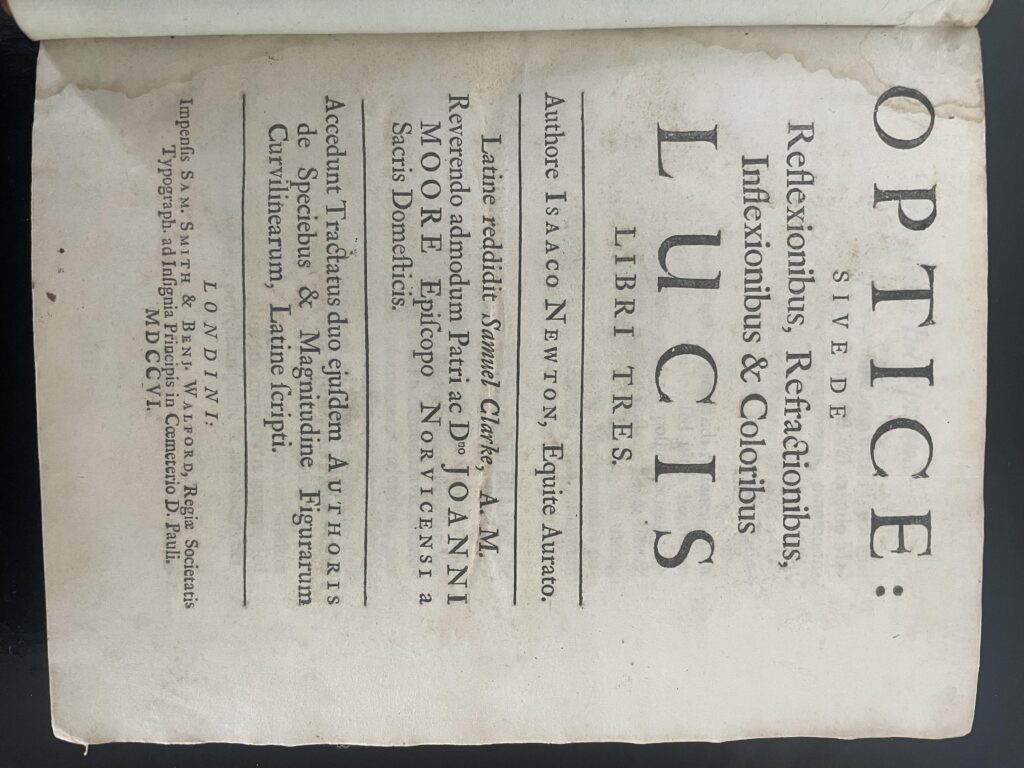
1901 · PLANCK
The Quantum Hypothesis
The radiation law that introduced energy quanta into the foundations of physics.
1911 · RUTHERFORD
The Nuclear Atom
The discovery of the atom’s concentrated nucleus, opening the way to quantum atomic theory.
1912 · FIRST SOLVAY CONFERENCE
Radiation and the Quanta
The proceedings of the 1911 gathering that confronted the growing crisis in classical physics.
1913 · BOHR
The Quantum Atom
Three foundational papers introducing quantised atomic states and a new understanding of atomic spectra.
1923 · COMPTON
The Particle Nature of Light
X-ray scattering provided decisive evidence for the energy and momentum of light quanta.
1924 · DE BROGLIE
The Wave Nature of Matter
The revolutionary proposal that particles of matter possess wave-like properties.
1925 · HEISENBERG
The Birth of Matrix Mechanics
A new mechanics built from observable quantities rather than classical electron orbits.
1926 · BORN · HEISENBERG · JORDAN
The Mathematics of Quantum Mechanics
The systematic development of matrix mechanics into a powerful mathematical theory.
1926 · SCHRÖDINGER
The Birth of Wave Mechanics
The wave equation that transformed the mathematical description of quantum systems.
1927 · THOMSON · REID
The Diffraction of Electrons
Experimental evidence confirming that electrons exhibit the wave behaviour predicted by de Broglie.
1928 · BOHR
The Principle of Complementarity
A new framework for understanding the apparently contradictory wave and particle descriptions of quantum phenomena.
Further into the Collection
Beyond the defining discoveries, these publications trace the development of quantum mechanics and its transmission through the libraries of the physicists who shaped it.
INSCRIBED BY BOHR TO J. A. CHRISTIANSEN
1923 · BOHR
The Structure of the Atom
Bohr’s Nobel Lecture surveyed the development of his quantum model of the atom, bringing together the discoveries that had transformed atomic physics.
FROM THE LIBRARY OF NIELS BOHR
1927 · JORDAN & KLEIN
The Quantisation of Wave Fields
Jordan and Klein developed a method for treating systems of identical particles, helping establish second quantisation and the foundations of quantum field theory.
1928 · VON NEUMANN
The Mathematical Foundations of Quantum Mechanics
Von Neumann’s early work helped establish a rigorous mathematical framework for quantum mechanics, replacing competing formulations with a more unified mathematical treatment.
FROM THE LIBRARY OF NIELS BOHR
1928 · HEISENBERG
The Quantum Theory of Ferromagnetism
Heisenberg used quantum-mechanical exchange interactions to explain ferromagnetism, demonstrating how the new mechanics could account for the magnetic properties of matter.
FROM THE LIBRARY OF HEISENBERG
1934–1935 · WESSEL
Electron Spin and Relativistic Quantum Theory
Two original offprints investigating electron spin and extensions of Dirac’s relativistic theory, documenting the continuing development of quantum mechanics.
TRANSLATED WITH C. N. YANG · COPY MARKED “B. SEGALL”
POSTWAR · PAULI · TRANSLATED WITH C. N. YANG
The General Principles of Wave Mechanics
A mimeographed English translation of Pauli’s work, prepared by young physicists including C. N. Yang, later a Nobel laureate.
Other LUMEN Works and Connections
The quantum revolution did not end with the creation of quantum mechanics. The wider LUMEN collection traces its origins, mathematical development and extension into the physics of fields, particles and fundamental symmetries.
1907 · EINSTEIN — Quantum Theory and Specific Heat
Einstein applied Planck’s quantum hypothesis to the specific heat of solids, demonstrating its significance beyond the theory of radiation.
1916 · SCHWARZSCHILD — The Quantum Hypothesis
An important contribution to the emerging quantum theory of atomic systems, developing methods that helped prepare the way for modern quantum mechanics.
1924 · BOHR, KRAMERS & SLATER — The Quantum Theory of Radiation
A bold attempt to reconcile quantum transitions with classical electromagnetic theory, proposing a statistical interpretation that was soon challenged by experiment.
1927 · DIRAC — The Quantum Theory of Dispersion
Dirac applied the new quantum mechanics to the interaction of radiation and matter, advancing the theoretical treatment of light and atomic systems.
1927 · KENNARD — The Uncertainty Relations
Kennard established a precise mathematical expression of quantum uncertainty, connecting the spreads of position and momentum.
1927 · DE BROGLIE — Extensions of Wave Mechanics
Two papers exploring the structure of matter and radiation and the relationship between wave mechanics and five-dimensional relativity, extending the implications of de Broglie’s matter-wave hypothesis.
1934 · DE BROGLIE — The Magnetic Electron
An investigation of Dirac’s theory of the electron, reflecting the continuing effort to understand spin and the relationship between quantum mechanics and relativity.
1940 · PAULI — The Connection Between Spin and Statistics
Pauli established the fundamental relationship between particle spin and quantum statistics, explaining the different behaviour of fermions and bosons.
1955 · GELL-MANN & PAIS — Neutral Particles and Charge Conjugation
An investigation of neutral particles and their behaviour under charge conjugation, contributing to the emerging understanding of particle symmetries.
1956 · LEE & YANG — The Question of Parity Conservation
Lee and Yang challenged the assumption that the weak interaction preserves mirror symmetry, helping transform the understanding of fundamental physical laws.
1958 · HEISENBERG — Physics and Philosophy
Heisenberg reflected on the conceptual and philosophical consequences of quantum mechanics, including uncertainty, causality and the nature of physical reality.
1962 · GELL-MANN — Symmetries of Baryons and Mesons
A systematic account of particle symmetries, contributing to the classification of hadrons and the theoretical developments that led towards the quark model.
A Revolution Still Unfolding
Quantum mechanics transformed the understanding of matter, radiation and physical reality. Its mathematical predictions became among the most successful in science, yet questions about measurement, causality and the nature of reality remain subjects of investigation and debate.
The publications gathered in LUMEN preserve the steps through which this transformation took place — and the intellectual connections between those who made it possible.