Physico-Mathesis de Lumine, Coloribus, et Iride · 1665
The Question
How does light behave?
Grimaldi’s experiments revealed that light behaved in ways that existing theories struggled to explain. By discovering and naming diffraction, he opened one of the most important scientific conversations in the history of physics, one that would ultimately lead from Newton’s Opticks to the wave theory of light and modern physics.
Why This Work Matters
Published shortly after Grimaldi’s death, Physico-Mathesis de Lumine, Coloribus, et Iride is one of the landmark works in the history of optics.
Working as a Jesuit mathematician in Bologna, Grimaldi carried out careful experiments showing that light spreads into the geometrical shadow of an obstacle. He named this phenomenon diffraction, providing the first systematic description of behaviour that could not readily be reconciled with simple geometrical optics.
Grimaldi did not provide its final theoretical explanation. Instead, his observations presented later physicists with a problem that any successful theory of light would have to explain. Diffraction became important evidence in the nineteenth-century development of wave optics and remains fundamental to our understanding of light.
The work therefore marks an important transition: from an optical science dominated by geometry towards one increasingly shaped by experiment.
Place in the History of Ideas
Foundations
By the middle of the seventeenth century, optics possessed a sophisticated mathematical tradition. Euclid, Ptolemy, Ibn al-Haytham, Kepler and Maurolico had developed increasingly powerful accounts of vision, reflection and refraction.
Yet the physical nature of light remained unknown.
This Work
Francesco Maria Grimaldi · Physico-Mathesis de Lumine · 1665
Grimaldi introduced a striking experimental challenge to the geometrical picture. Light appeared to travel in straight lines, yet his experiments showed that it could spread beyond the boundaries predicted by simple ray geometry.
He called the phenomenon diffraction.
The discovery demonstrated that light possessed behaviours that geometry alone could not fully describe and made experiment increasingly important to understanding its physical nature.
Immediate Legacy
Grimaldi’s diffraction experiments posed a problem for subsequent theories of light.
Newton incorporated Grimaldi’s observations into his investigations while attempting to account for diffraction within his own theory. More than a century later, Young’s experiments with interference revived the idea that light behaves as a wave.
Fresnel then showed mathematically how wave theory could account for diffraction itself.
Long-Term Influence
Diffraction became one of the central phenomena through which the nature of light was investigated.
The path from Grimaldi led through Young and Fresnel’s wave optics to Maxwell’s electromagnetic theory and eventually to quantum physics, where diffraction and interference remain fundamental manifestations of the behaviour of light.
The Conversation
INHERITED
Euclid · Ptolemy · Ibn al-Haytham · Kepler · Maurolico
Geometry and observation had created a sophisticated science of optics, but the physical nature of light remained unknown.
GRIMALDI · 1665
Experiment revealed a phenomenon that geometrical optics could not adequately explain: diffraction.
PASSED ON
Newton · Young · Fresnel · Maxwell · Einstein
Explaining diffraction became part of the larger search to understand whether light was composed of particles, waves, or something more fundamental.
LUMEN Insight
The most important experiments are often ones that existing theory cannot explain.
Grimaldi’s discovery did not immediately produce a new theory of light. Its importance lay in exposing the limits of the old one. Diffraction became a problem passed from one generation to the next, helping drive the transformation of optics over the following two centuries.
Why this Copy Matters
LUMEN’s copy has an exceptional scientific provenance that connects Grimaldi’s discovery of diffraction with the intellectual world surrounding Isaac Newton.
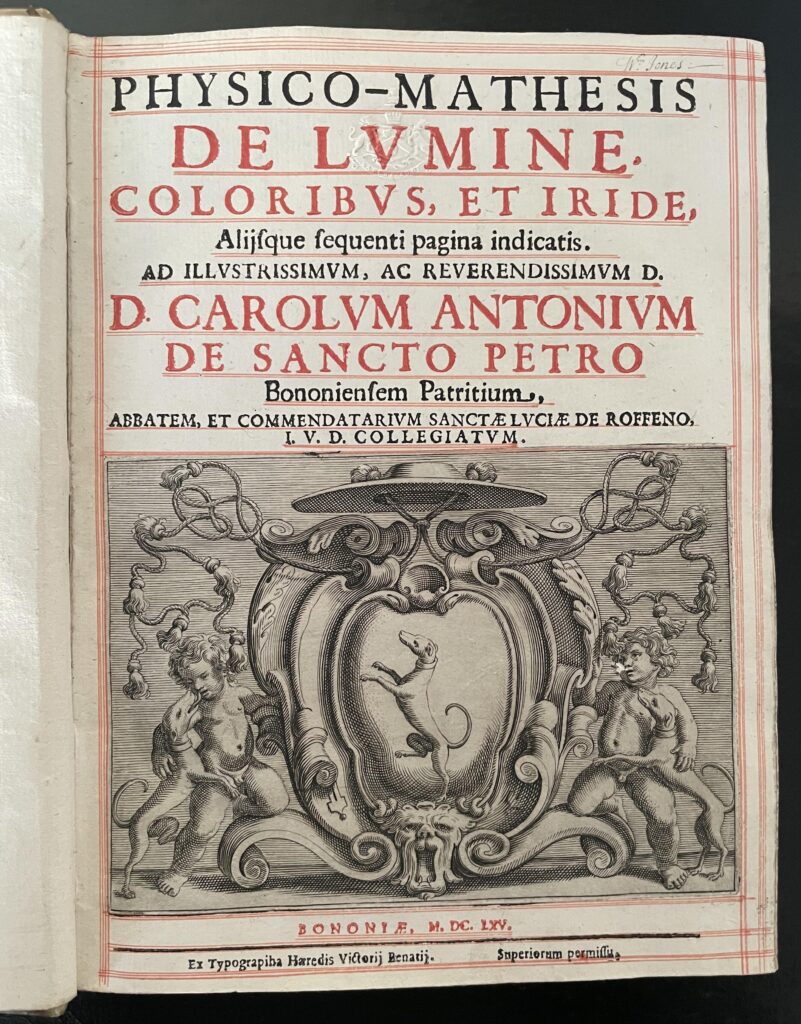
The volume belonged to William Jones (1675–1749), mathematician and Fellow of the Royal Society, who introduced the symbol π for the ratio of a circle’s circumference to its diameter in 1706. Jones was closely connected with Newton and was entrusted with publishing Newton’s Analysis per quantitatum series in 1711. His ownership name appears at the head of the title page.
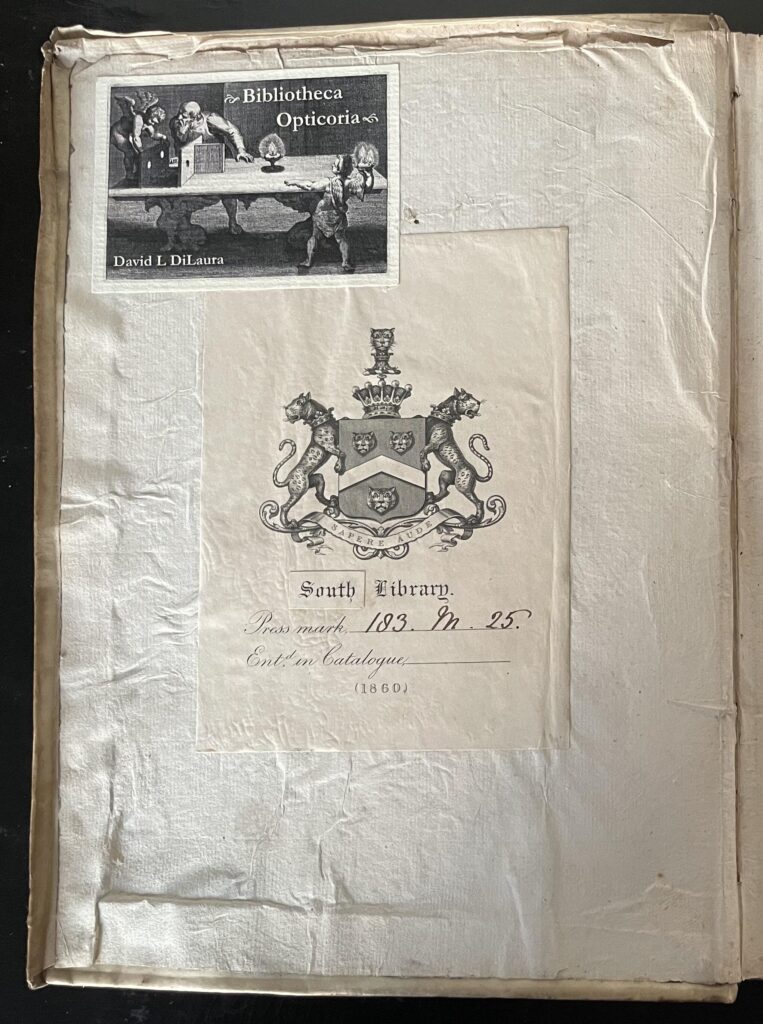
The book subsequently entered the Library of the Earls of Macclesfield, where its history is recorded by the South Library bookplate, shelf-mark and Macclesfield embossed stamps. It later formed part of David L. DiLaura’s Bibliotheca Opticoria, a major modern collection devoted to the history of optics.
Its provenance therefore traces an unusual path through three important contexts for the history of science: William Jones and the Newtonian circle, the Macclesfield scientific library, and DiLaura’s modern collection of historical optics.
The Copy
First edition. Bologna: heirs of Vittorio Benacci, 1665. Quarto.
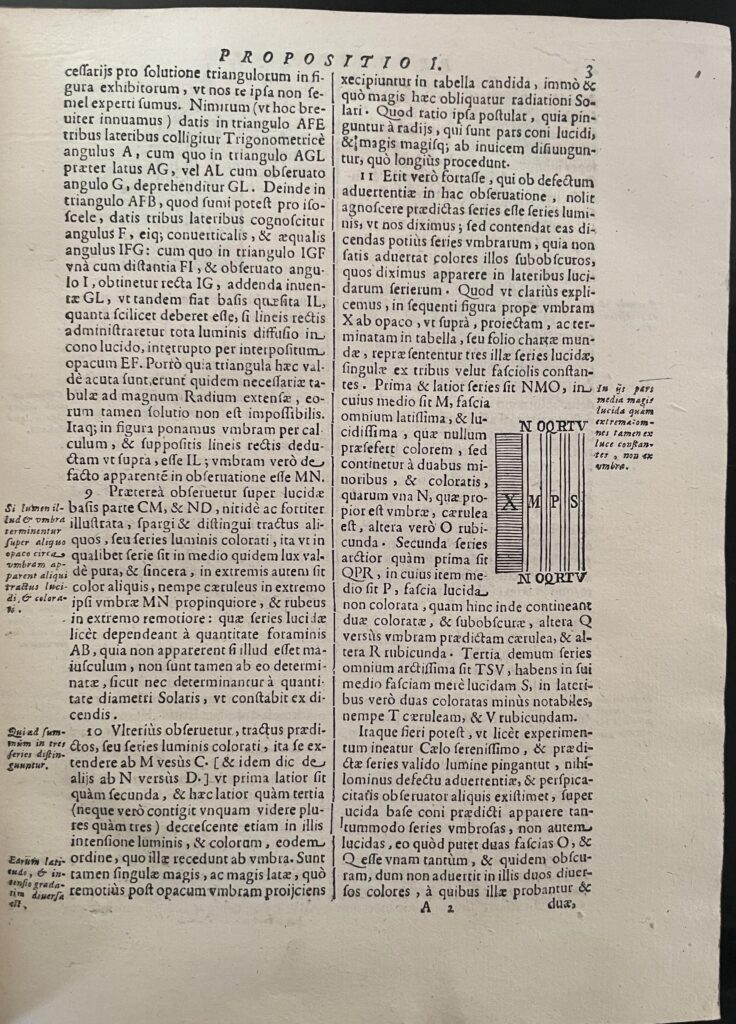
Grimaldi’s only book was published posthumously in 1665. The title is printed in red and black with a large engraved coat of arms and has additionally been ruled in red. The volume contains numerous woodcut diagrams illustrating Grimaldi’s optical investigations.
This copy retains the initial blank but lacks the additional letterpress title, which appears to have been removed around the time of binding.
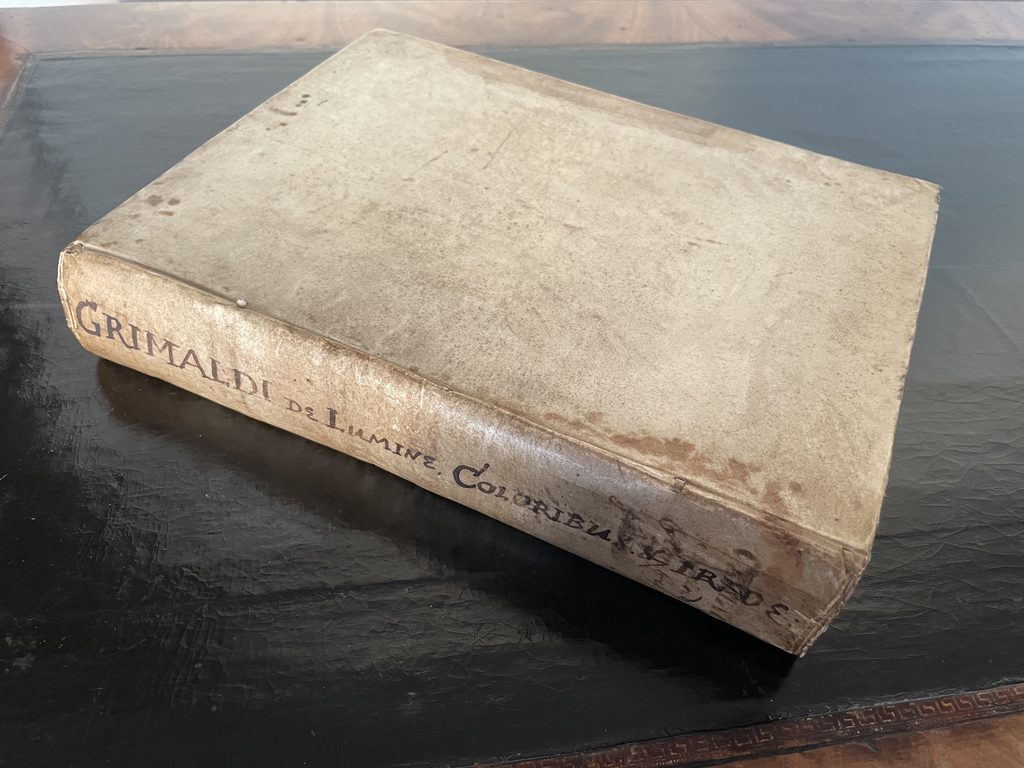
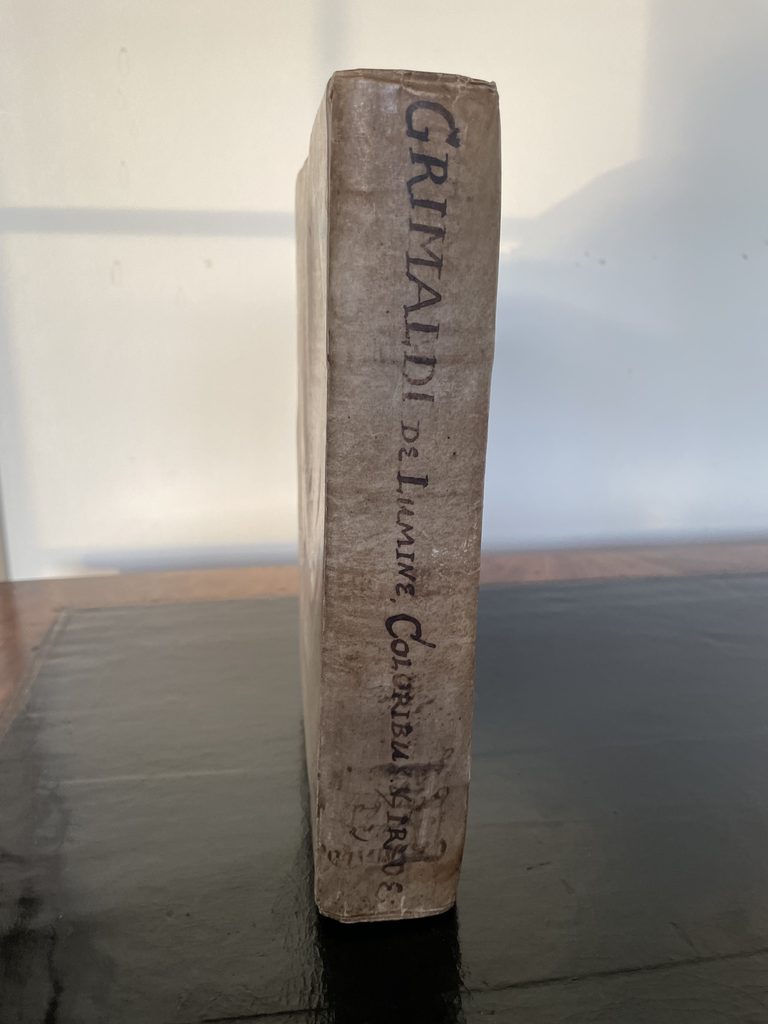
The book survives in contemporary vellum with yapp edges, with a manuscript title on the spine. Unlike Maurolico’s modern vellum binding, this therefore preserves an important part of the book’s seventeenth-century physical history.
A Scientific Life
William Jones (1675–1749)
Mathematician and Fellow of the Royal Society
Introduced the symbol π for the ratio of a circle’s circumference to its diameter in 1706
Associate of Isaac Newton
Ownership name on title page
↓
Library of the Earls of Macclesfield
South Library bookplate, shelf-mark and embossed stamps
↓
David L. DiLaura
Bibliotheca Opticoria bookplate
↓
The LUMEN Library
The sequence is particularly appropriate to this book. Grimaldi’s diffraction experiments became part of the debate over the nature of light that Newton would confront. This copy subsequently belonged to Jones, who was closely associated with Newton, before passing through two distinguished collections concerned with mathematics and optics.
Bibliographical Details
GRIMALDI, Francesco Maria.
Physico-mathesis de lumine, coloribus, et iride.
Bologna: heirs of Vittorio Benacci, 1665.
Edition: First edition
Format: 4to
Illustration: Title printed in red and black with large engraved coat of arms; woodcut diagrams
Binding: Contemporary vellum, yapp edges; manuscript title to spine
Condition: Very good and clean; some very light browning; binding soiled and spine darkened
Completeness: Initial blank present; lacking a1 additional letterpress title
Provenance: William Jones (ownership name); Library of the Earls of Macclesfield (South Library bookplate, pencil shelf-mark and embossed stamps); David L. DiLaura, Bibliotheca Opticoria (bookplate)
Copy Notes: Title additionally ruled in red. The additional letterpress title appears to have been excised, probably at the time of binding.
References: Riccardi I, 631
Gallery
Grimaldi marks the transition from Renaissance mathematical optics to experimental physics. His discovery of diffraction begins one of the central scientific conversations explored throughout the LUMEN Library.
Earlier Context
○ Kepler — retinal image formation
● Maurolico – Renaissance geometrical optics
This Work
★ Grimaldi — diffraction
Later Developments
● Newton — colour and corpuscular theory
○ Bouguer — early photometry
● Lambert — photometry
Related Galleries
- The Scientific Method
- Matter and Energy
- The Quantum Revolution
Atlas Connections
People
Grimaldi • Newton • William Jones • Maxwell • Hertz • Einstein
Ideas
Diffraction • Experiment • Observation • Wave–particle duality