Photismi de lumine et umbra · 1611

The Question
How can light be understood through mathematics?
Long before diffraction, electromagnetism or quantum theory, mathematicians sought to explain light using geometry. Maurolico’s Photismi represents one of the culminating achievements of Renaissance geometrical optics, preserving the classical tradition while pointing towards the experimental science of the seventeenth century.
Why This Work Matters
Published in 1611, shortly after Maurolico’s death, Photismi de Lumine et Umbra is one of the most important Renaissance works devoted to optics.
Building upon the traditions established by Euclid, Ptolemy and Ibn al-Haytham, Maurolico investigated reflection, refraction, shadows, perspective and the mathematical behaviour of light. His treatment was deeply rooted in geometry, reflecting a view of optics in which mathematical reasoning provided the principal means of understanding vision and illumination.
Although later developments would increasingly rely upon experiment, Maurolico occupies a pivotal historical position. His work marks one of the last great syntheses of classical geometrical optics before the Scientific Revolution transformed the study of light through systematic observation and experiment.
Today Photismi stands as one of the principal bridges between medieval natural philosophy and modern optical science.
Place in the History of Ideas
Foundations
The study of light began in antiquity. Euclid demonstrated that geometry could describe visual phenomena, while Ptolemy expanded the mathematical treatment of reflection and refraction. Centuries later, Ibn al-Haytham (Alhazen) united mathematics with careful experiment, establishing optics as one of the most rigorous branches of natural philosophy.
By the sixteenth century, however, much of this knowledge remained dispersed across Greek, Arabic and medieval traditions.
This Work
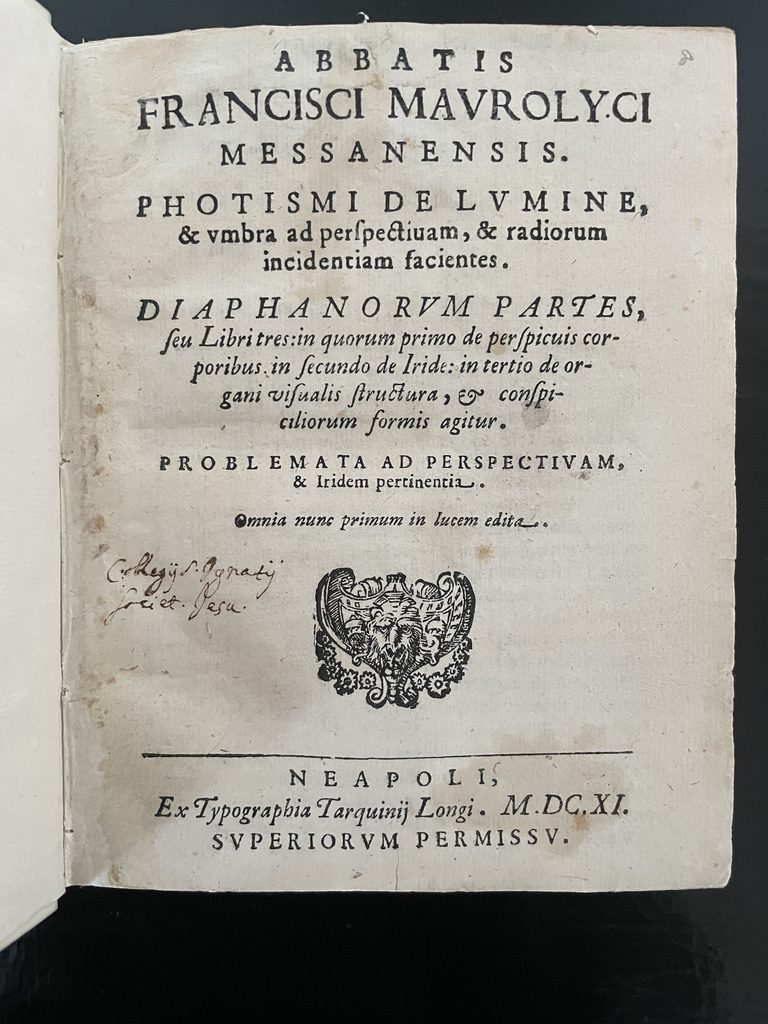
Francesco Maurolico – Photismi de Lumine (1611)
Maurolico brought these traditions together within the mathematical culture of the Renaissance. His work revived geometrical optics, clarified many classical results, and demonstrated that the behaviour of light could be investigated through precise mathematical reasoning.
Rather than proposing a new physical theory of light, Maurolico established the mathematical language through which later generations would begin to understand it.
Immediate Legacy
Maurolico’s work formed part of the intellectual foundation upon which the Scientific Revolution was built.
Johannes Kepler extended geometrical optics to explain the formation of images within the eye.
Francesco Maria Grimaldi transformed optics into an experimental science through the discovery of diffraction. Isaac Newton combined mathematical analysis with experiment to construct the first comprehensive physical theory of light.
Long-Term Influence
Maurolico marks the beginning of the LUMEN narrative.
His mathematical approach underpins the entire development of optical science, leading ultimately through Grimaldi’s experiments, Newton’s optics, the wave theory of Young and Fresnel, Maxwell’s electromagnetic theory and Einstein’s quantum conception of light.
The Conversation
INHERITED
Euclid · Ptolemy · Ibn al-Haytham
Geometry provided the language through which light and vision could be understood.
MAUROLICO · 1611
Preserved, clarified and extended the geometrical tradition of optics.
PASSED ON
Kepler · Grimaldi · Newton
Geometry gave way increasingly to observation and experiment, opening the path towards a physical science of light.
LUMEN Insight
Every scientific revolution begins with inherited knowledge.
Maurolico’s importance lies not in overturning the science of light, but in preserving, clarifying and transmitting the mathematical tradition on which later discoveries could build. Scientific revolutions depend not only on those who overturn accepted ideas, but also on those who pass inherited knowledge to the next generation.
Why this Copy Matters
This is the earliest major work on optics currently represented in the LUMEN Library, but its significance extends beyond its chronological position.
The volume carries a contemporary inscription from the Jesuit College of St. Ignatius and later formed part of David L. DiLaura’s Bibliotheca Opticoria, linking an early institutional library with one of the notable modern collections devoted to the history of optics.
It also preserves both cancelland and cancel leaves, an apparently unrecorded feature that gives this copy unusual bibliographical interest. Together, its text, provenance and physical evidence make the volume an unusually rich witness to the transmission of optical knowledge across centuries.
The Copy
First edition. Naples: Tarquinio Longo, 1611. Quarto. Latin.
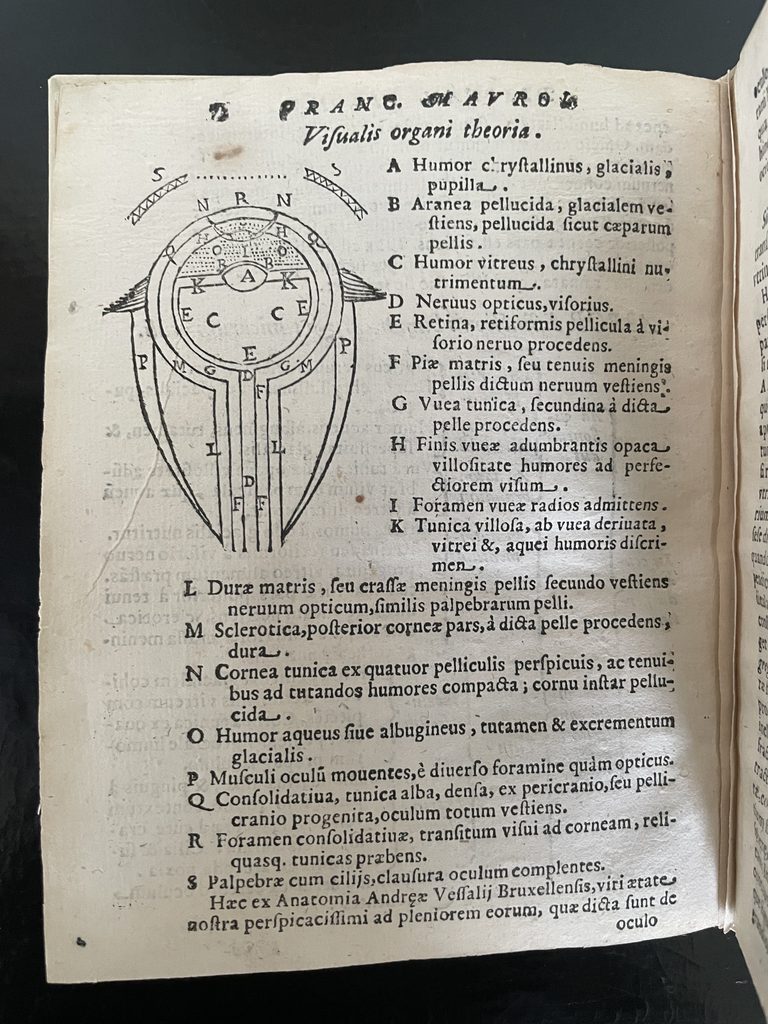
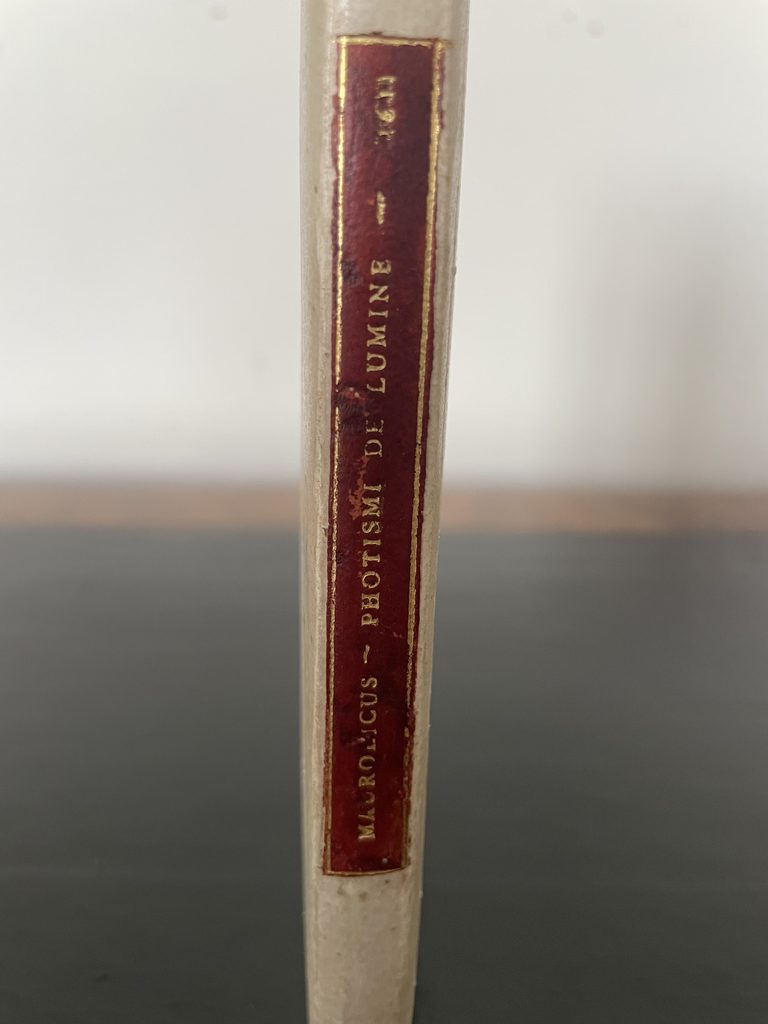
Published posthumously, this copy is bound in modern vellum and retains the woodcut geometrical and optical diagrams for which the work is noted, including its representation of the anatomy of the human eye.
Most unusually, the volume preserves both cancelland and cancel leaves. Their survival together appears to be unrecorded, providing evidence of changes made during the printing of the first edition and giving this copy particular bibliographical interest.
A Life In Optics
The title page bears a contemporary ownership inscription from the Jesuit College of St. Ignatius, placing the volume within an institutional tradition in which books were acquired, studied and transmitted as working instruments of knowledge.
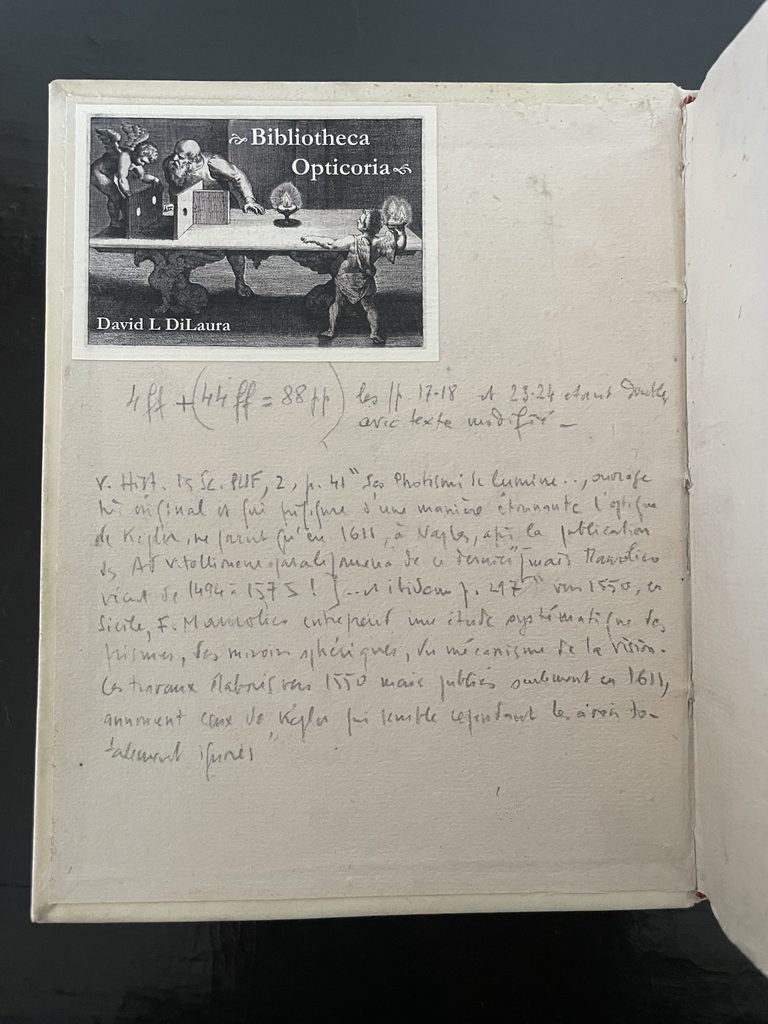
Centuries later, the volume entered the collection of David L. DiLaura, historian of optics and creator of the Bibliotheca Opticoria. His bookplate records its place within a modern collection devoted specifically to the history of optical science.
The provenance therefore gives the book a second history alongside the one contained in its printed pages: from an early Jesuit library to one of the major modern collections devoted to the history of optics.
Bibliographical Details
MAUROLICO, Francesco.
Photismi de lumine, & umbra ad perspectiuam, & radiorum incidentiam facientes.
Naples: Tarquinio Longo, 1611.
Edition: First edition
Format: 4to
Language: Latin
Illustration: Woodcut diagrams, including anatomy of the human eye
Binding: Modern vellum
Condition: Very good; complete. Neat repairs to the title and first leaves; occasional marginal repairs; short repaired tear to C1; light worming and occasional staining.
Provenance: Jesuit College of St. Ignatius; David L. DiLaura, Bibliotheca Opticoria
Copy notes: Preserves both cancelland and cancel leaves; apparently unrecorded in this form.
References: USTC; Norman; Sarton, Six Wings: Men of Science in the Renaissance
Gallery
This work marks the beginning of LUMEN’s exploration of the early modern science of light. It represents the culmination of the Renaissance geometrical tradition and forms the foundation upon which the later experimental revolution is built.
Earlier Context
○ Euclid — geometry of vision
○ Ptolemy — reflection and refraction
○ Ibn al-Haytham — experimental optics
○ Kepler — retinal image formation
This Work
● Maurolico – Renaissance geometrical optics
Later Developments
★ Grimaldi — diffraction
● Newton — colour and corpuscular theory
Related Galleries
- The Scientific Method
- Matter and Energy
Atlas Connections
People
Maurolico • Euclid • Ibn al-Haytham • Kepler • Grimaldi
Ideas
Geometry • Vision • Reflection • Refraction • Renaissance Science