De la Lumière and Quelques observations sur les principales objections de Newton… · 1823
The Question
Can the wave theory explain light completely?
Young had restored the wave theory of light to serious scientific consideration. Fresnel went much further. Through a remarkable combination of experiment and mathematics, he developed wave optics into a predictive physical theory capable of explaining diffraction, interference and polarization.
The LUMEN volume, published in 1823, belongs to the period in which Fresnel was consolidating and defending this new understanding of light.
Why This Work Matters
Augustin-Jean Fresnel transformed the wave theory of light.
Young had shown that interference provided powerful evidence for wave behaviour, but Fresnel developed the mathematical and experimental framework through which a much wider range of optical phenomena could be understood.
His investigations of diffraction were central to this achievement. Building upon phenomena first observed by Grimaldi, Fresnel showed that the apparently complex patterns produced when light encounters obstacles could be predicted through the interference of waves.
His prize memoir on diffraction, submitted to the French Academy of Sciences in 1818, produced one of the celebrated episodes in nineteenth-century physics. Siméon-Denis Poisson pointed out that Fresnel’s mathematics implied a bright point at the centre of the shadow of a circular obstacle. The phenomenon was experimentally confirmed, strengthening the case for the wave theory.
Fresnel’s work extended beyond diffraction to polarization and transverse waves, helping establish a sophisticated wave theory that would dominate nineteenth-century optics.
Place in the History of Ideas
Foundations
For more than a century, Newton’s corpuscular account had provided the dominant framework for thinking about light.
Yet difficulties remained. Grimaldi’s diffraction and other optical phenomena resisted simple corpuscular explanation, while Huygens had developed an alternative wave conception. At the beginning of the nineteenth century, Young’s work on interference supplied powerful new evidence for wave behaviour.
The challenge was now to turn that insight into a comprehensive physical theory.
Fresnel’s Breakthrough
Augustin-Jean Fresnel · Wave Optics · from 1815
Fresnel united experiment with increasingly sophisticated mathematical analysis.
His treatment of diffraction showed that the observed patterns of light and darkness could be understood through the superposition and interference of waves. His subsequent investigations of polarization helped establish that the vibrations associated with light must be transverse rather than longitudinal.
Wave optics was becoming more than an alternative interpretation of isolated experiments. It was becoming a mathematical framework capable of making successful predictions about nature.
Immediate Legacy
Fresnel’s work established wave optics as the principal framework for nineteenth-century optical physics.
But it also created new questions. If light consisted of transverse waves, what exactly was waving? What mechanical properties would the supposed luminiferous ether require?
Physicists and mathematicians including Cauchy would attempt to develop increasingly sophisticated mathematical theories of optical propagation, dispersion and crystalline media.
Long-Term Influence
The wave theory underwent another transformation with Maxwell.
Maxwell’s electromagnetic theory identified light with electromagnetic waves, connecting optics with electricity and magnetism. Hertz subsequently provided experimental evidence for electromagnetic radiation.
Quantum physics then complicated the picture again. Einstein’s light quantum showed that a purely classical wave description could not account for every phenomenon.
Fresnel’s achievement nevertheless endured. Diffraction, interference and wave propagation remain fundamental to physical optics, even though the physical interpretation of light changed profoundly.
The Conversation
INHERITED
Grimaldi · Huygens · Newton · Young
Diffraction and interference had exposed limitations in the corpuscular description of light, while Young had restored the wave theory to serious consideration.
FRESNEL · 1815–1820s
Experiment and mathematics transformed wave optics into a powerful predictive theory.
PASSED ON
Cauchy · Maxwell · Hertz · Einstein
Wave optics became the foundation for nineteenth-century theories of light before electromagnetism and quantum physics transformed its physical interpretation again.
LUMEN Insight
The power of a scientific theory lies not only in explaining what is already known, but in predicting what should be observed.
Fresnel’s mathematics transformed the wave theory from an interpretation of optical phenomena into a predictive framework. The subsequent confirmation of unexpected consequences of that theory demonstrated the increasingly close relationship between mathematics, experiment and physical explanation.
Why this Copy Matters
LUMEN’s volume documents an important stage in the establishment, defence and communication of Fresnel’s wave theory following his pioneering work on diffraction.
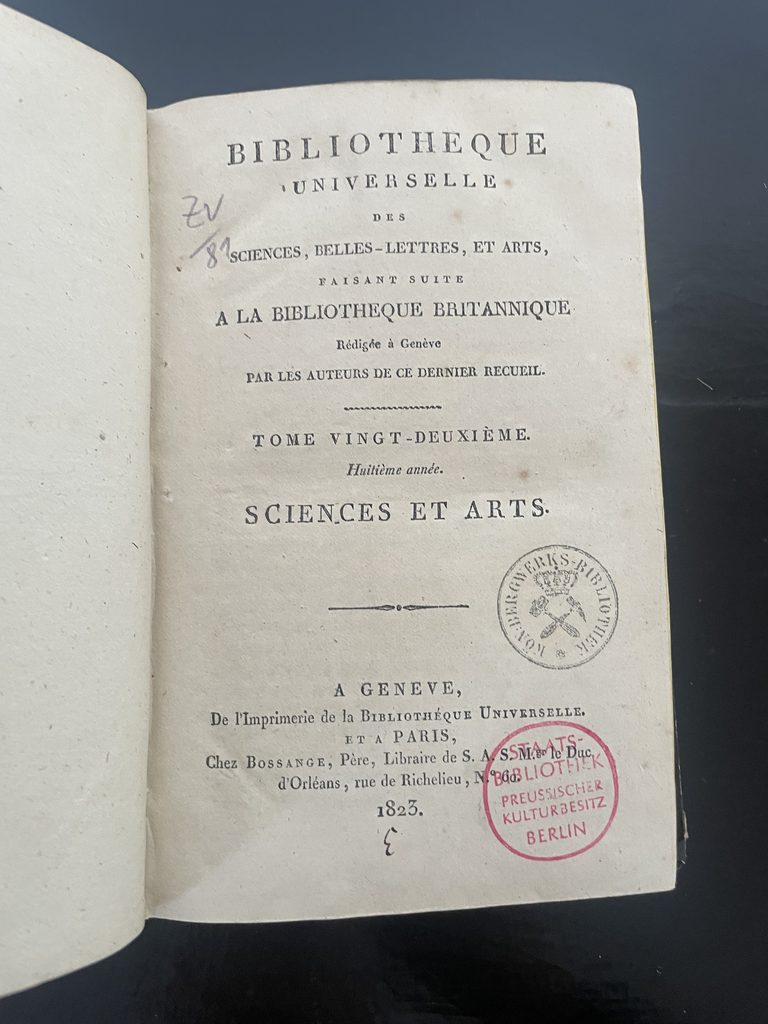
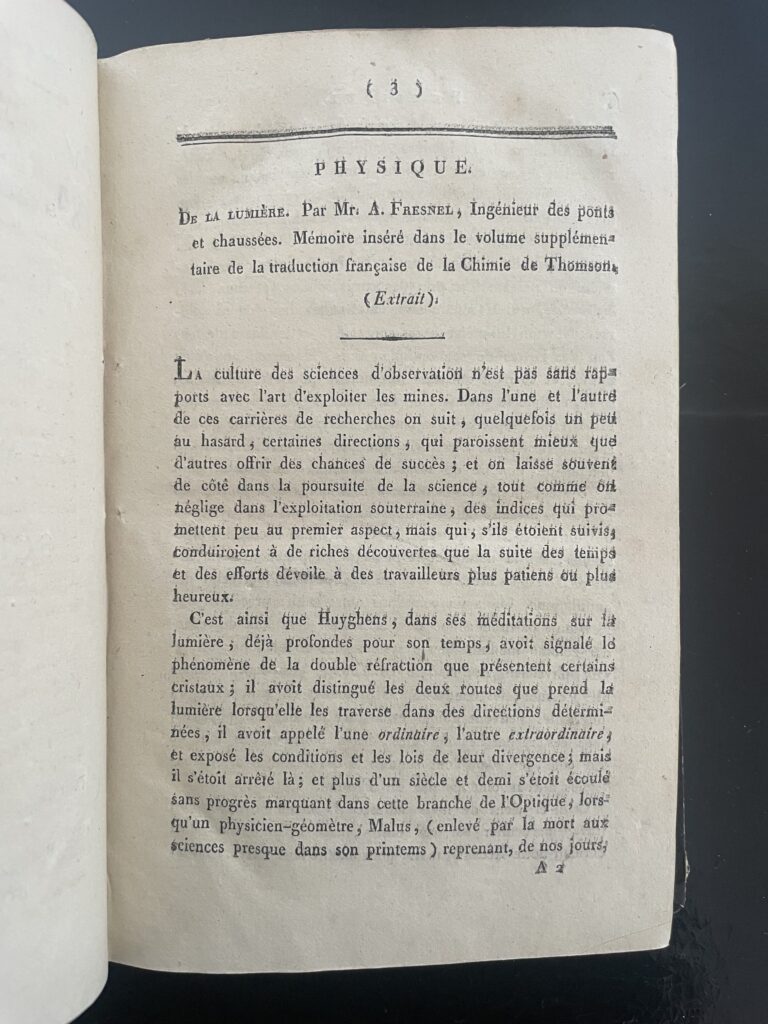
Published in Geneva in 1823, the volume contains two contributions by Fresnel: De la Lumière and Quelques observations sur les principales objections de Newton contre le système des vibrations lumineuses et sur les difficultés que présente son hypothèse des accès.
The second is particularly revealing within the LUMEN narrative. Fresnel directly addresses Newton’s objections to a vibrational theory of light and the difficulties presented by Newton’s hypothesis of “fits”, bringing competing explanations of light into explicit confrontation.
The volume therefore captures a particularly interesting stage in the life of a scientific idea. Fresnel’s wave theory is no longer simply emerging: it is being explained, defended and transmitted to a wider scientific audience.
The Copy

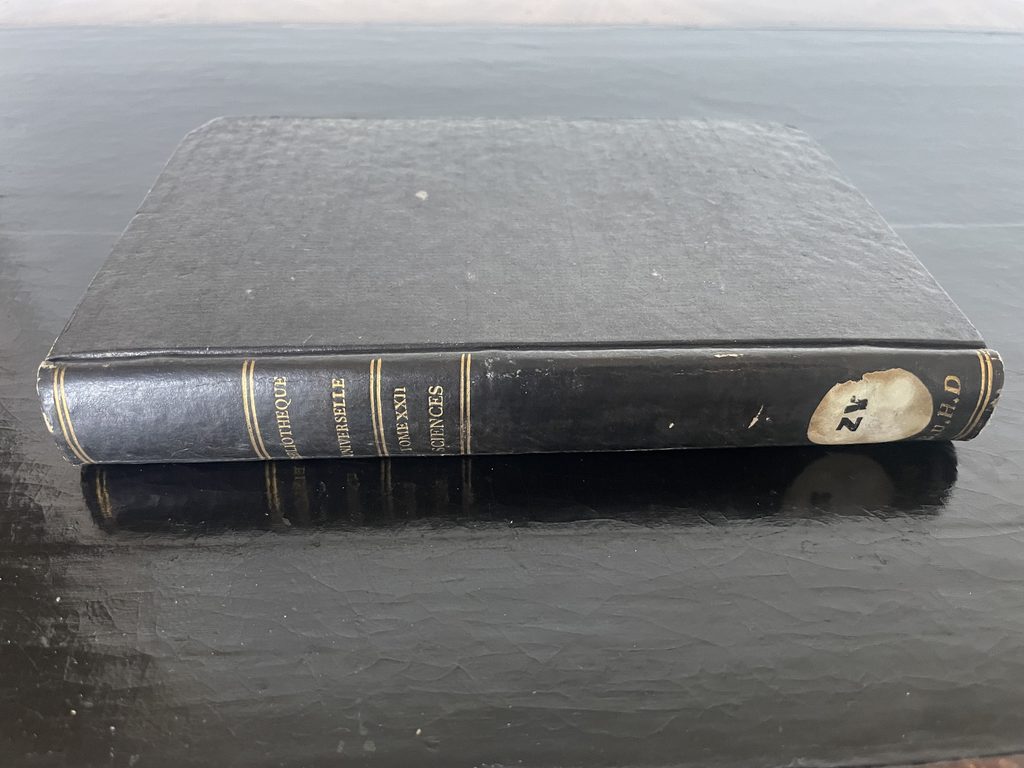
Geneva: Bibliothèque Universelle des Sciences, Belles-Lettres et Arts, Tome XXII (Sciences et Arts), 1823.
The volume contains two contributions by Fresnel:
De la Lumière
pp. 3–17
Quelques observations sur les principales objections de Newton contre le système des vibrations lumineuses et sur les difficultés que présente son hypothèse des accès
pp. 73–90
The second paper is particularly appropriate to the Gallery narrative. Newton and Fresnel are physically brought into the same intellectual conversation, with Fresnel addressing objections made by Newton against the wave conception of light.
A Scientific Journal Across Borders
Fresnel’s papers appeared not in isolation but within the Bibliothèque Universelle, a Geneva journal that communicated scientific work across national boundaries.
The form of the LUMEN object therefore reflects the movement of scientific ideas itself. Fresnel’s work, developed in France and responding to a debate involving Newton and Young, reached readers through a Swiss scientific journal intended to circulate knowledge beyond national boundaries.
Beyond Optics
The same volume also contains an 1823 notice by Félix Savary and Jean-Firmin Demonferrand concerning electrodynamics, providing an intriguing contemporary juxtaposition. Within a single scientific volume, investigations of wave optics sit alongside the developing science of electrical forces.
A Life in Libraries
Kong. Bergwerks Bibliothek
Royal Mining Library
↓
Staatsbibliothek, Berlin
↓
The LUMEN Library
The institutional markings form part of the history of the object rather than merely evidence of deaccession. They record the volume’s passage through scientific and research libraries before its arrival in LUMEN.
Bibliographical Details
FRESNEL, Augustin-Jean.
“De la Lumière,” pp. 3–17; and “Quelques observations sur les principales objections de Newton contre le système des vibrations lumineuses et sur les difficultés que présente son hypothèse des accès,” pp. 73–90.
In Bibliothèque Universelle des Sciences, Belles-Lettres et Arts, Tome XXII, Sciences et Arts.
Geneva: Imprimerie de la Bibliothèque Universelle, 1823.
Publication: Contemporary journal publication
Format: 8vo, approximately 20 × 13.5 cm
Pagination: 327 pp.
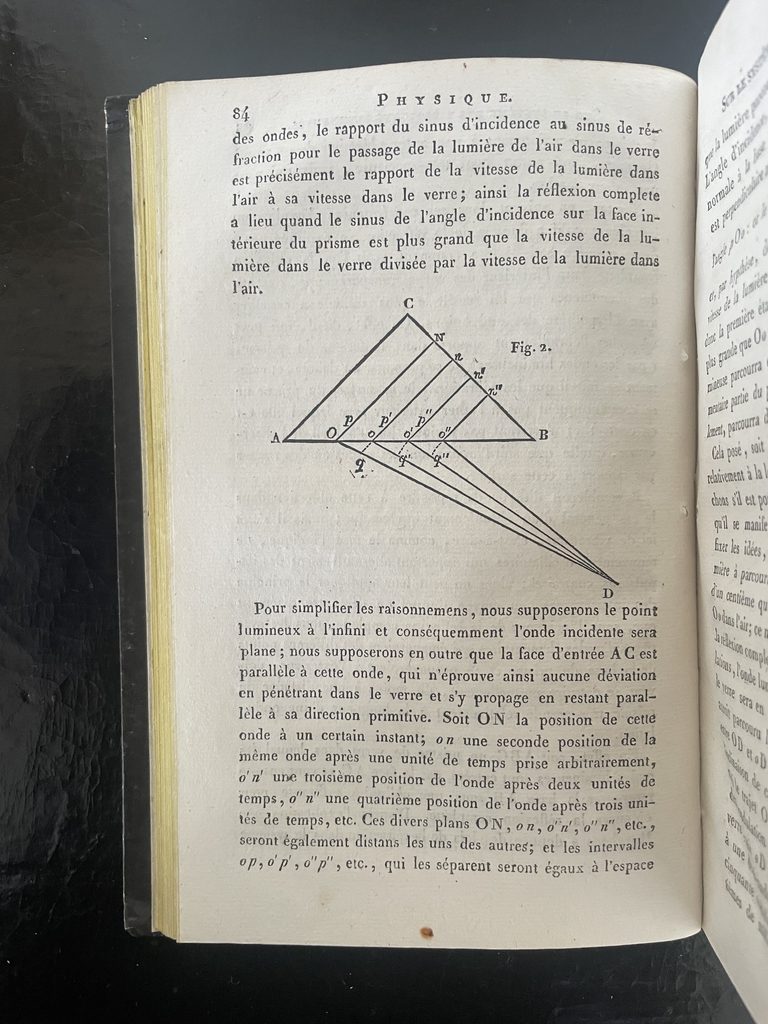
Illustration: Two folding plates in the volume
Binding: Black cloth over boards, gilt-lettered and ruled spine
Condition: Very good; binding firm; text fresh and crisp; institutional shelf label and library markings
Provenance: Königliche Bergwerks-Bibliothek; Staatsbibliothek, Berlin
Other Significant Contents: Félix Savary and Jean-Firmin Demonferrand, notice concerning two memoirs on electrodynamics, pp. 259–264
Gallery
Fresnel occupies the point at which the wave theory of light became a sophisticated mathematical and experimental framework. The LUMEN volume represents the subsequent defence and communication of that theory in 1823.
Earlier Context
● Lambert — photometry
● Young — interference and wave behaviour
This Work
● Fresnel — mathematical wave optics
Later Developments
★ Maxwell — electromagnetic light
★ Hertz — experimental confirmation
● Einstein — light quanta
Related Galleries
- The Language of Mathematics
- The Scientific Method
- Electricity and Electromagnetism
- The Quantum Revolution
Atlas Connections
People
Fresnel · Grimaldi · Huygens · Newton · Young · Cauchy · Maxwell · Hertz · Einstein
Ideas
Wave Theory · Diffraction · Interference · Polarization · Transverse Waves · Mathematical Physics · Experiment · Scientific Transmission