Traité d’électricité et de magnétisme · 1885–87
First French edition
The Question
Is light an electromagnetic wave?
For centuries, light had been studied as an optical phenomenon. Maxwell revealed that it belonged to something much larger.
By bringing electricity and magnetism into a single mathematical theory, Maxwell showed that electromagnetic disturbances should travel through space at the measured speed of light. The implication was extraordinary: light itself was an electromagnetic wave.
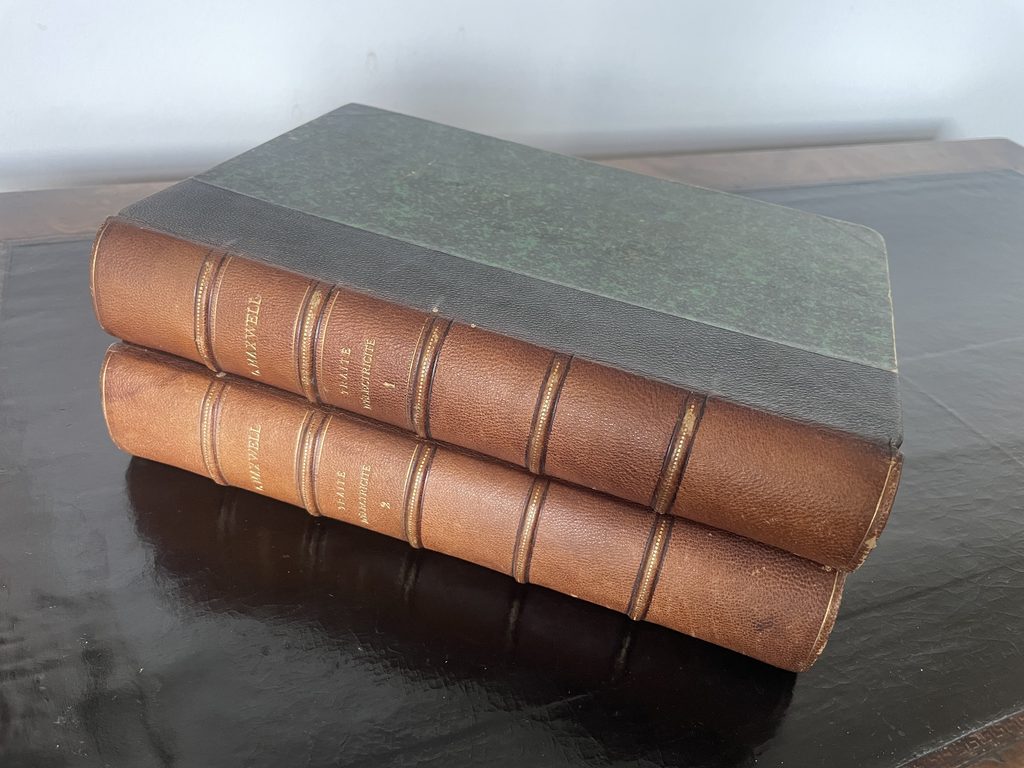
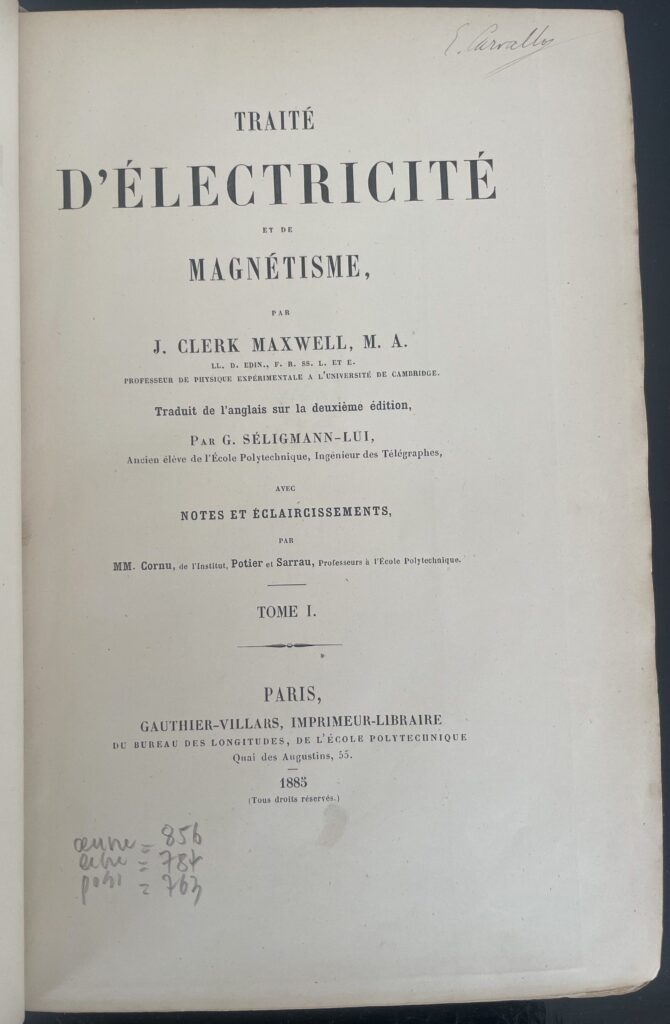
The LUMEN copy is the first French edition of Maxwell’s Treatise on Electricity and Magnetism, published in 1885–87 and extensively annotated by the French physicist Emmanuel Carvallo.
Why This Work Matters
James Clerk Maxwell achieved one of the great unifications in the history of science.
During the nineteenth century, electricity, magnetism and light had largely developed as separate fields of investigation. Drawing particularly upon the experimental discoveries and physical insights of Michael Faraday, Maxwell constructed a mathematical theory in which electricity and magnetism became interconnected aspects of an electromagnetic field.
A crucial consequence emerged from the mathematics.
Maxwell found that electromagnetic disturbances should propagate through space as waves, at a velocity remarkably close to the experimentally measured speed of light.
He concluded that light itself was an electromagnetic phenomenon.
Optics was therefore no longer an isolated branch of physics. The phenomena investigated by Newton, Young and Fresnel became part of a much broader description of nature.
Maxwell developed these ideas through a series of papers during the 1850s and 1860s, culminating in A Dynamical Theory of the Electromagnetic Field in 1865. He subsequently gave the theory its great systematic exposition in A Treatise on Electricity and Magnetism, first published in 1873.
Place in the History of Ideas
Foundations
By the middle of the nineteenth century, the wave theory of light had become firmly established.
Young had demonstrated the importance of interference. Fresnel developed wave optics into a powerful mathematical theory capable of explaining diffraction and polarization. At the same time, Faraday’s experiments had revealed profound relationships between electricity and magnetism and encouraged a new conception of physical forces acting through fields.
These traditions now converged.
The question was no longer simply how light behaves, but what light actually is.
Maxwell’s Unification
James Clerk Maxwell · Electromagnetic Light · 1860s
Maxwell translated the developing physics of electricity and magnetism into a mathematical field theory.
His equations implied the existence of electromagnetic waves. When their predicted velocity corresponded with the measured velocity of light, Maxwell recognised the deeper connection: light was an electromagnetic wave.
A centuries-old investigation into the nature of light had become part of a unified theory of electricity and magnetism.
Immediate Legacy
Maxwell’s theory made a remarkable prediction: electromagnetic waves should exist beyond the forms of radiation already visible as light.
In the 1880s, Heinrich Hertz generated and detected electromagnetic waves experimentally.
Hertz’s experiments provided powerful confirmation of Maxwell’s theory and demonstrated that electromagnetic radiation could be produced, transmitted and detected in the laboratory.
Long-Term Influence
Maxwell’s theory became one of the foundations of modern physics.
It transformed the understanding of light, electricity and magnetism and provided the theoretical basis for technologies ranging from radio and telecommunications to radar and modern electrical engineering.
It also created new theoretical problems. The relationship between Maxwellian electromagnetism and mechanics contributed directly to the transformations in physics associated with Lorentz, Einstein and special relativity.
Quantum theory would subsequently reveal that light could not be understood through classical electromagnetic waves alone.
The Conversation
INHERITED
Young · Fresnel · Faraday
MAXWELL · 1860s
PASSED ON
Hertz · Einstein
LUMEN Insight
Some of the greatest advances in science come from discovering that apparently different phenomena are manifestations of the same underlying reality.
Maxwell did more than produce a new theory of light. He united optics with electricity and magnetism, revealing a deeper structure beneath phenomena that had previously appeared separate.
Why this Copy Matters
LUMEN’s first French edition of Maxwell’s Treatise on Electricity and Magnetism records something different from the first appearance of Maxwell’s theory.
It documents what happened to the theory afterwards.
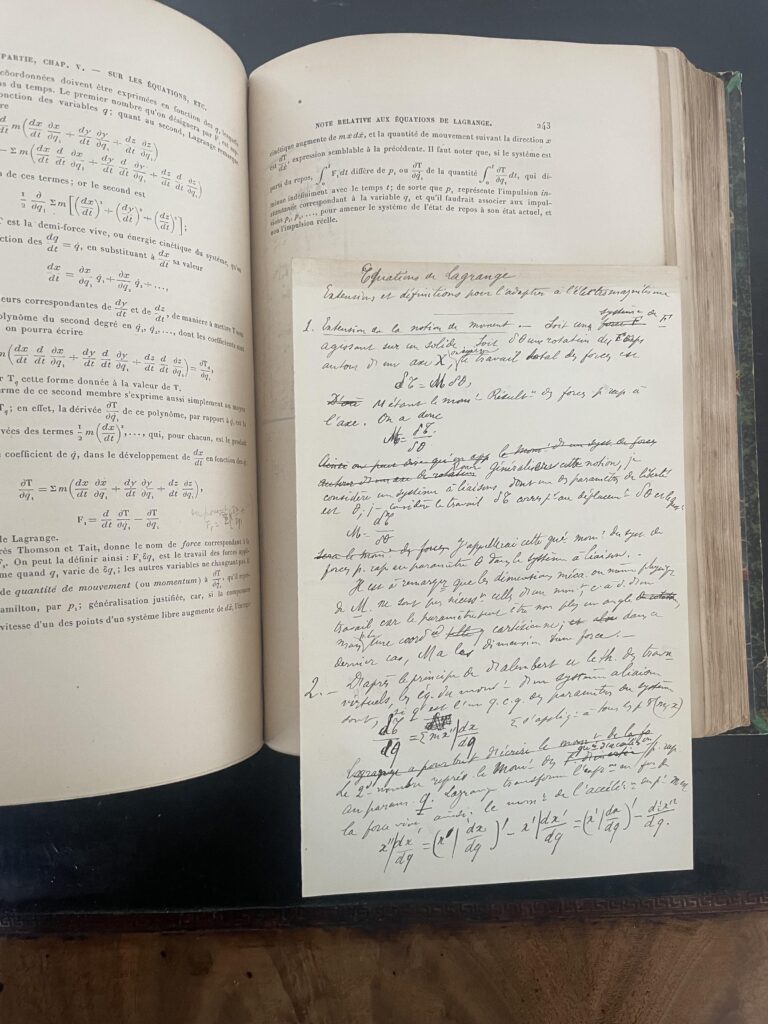
Published in Paris in 1885–87, the two volumes brought Maxwell’s great synthesis to a French-speaking scientific audience. This copy was then extensively annotated by Emmanuel Carvallo (1856–1945), a French physicist and mathematician who later served as Director of Studies at the École Polytechnique.
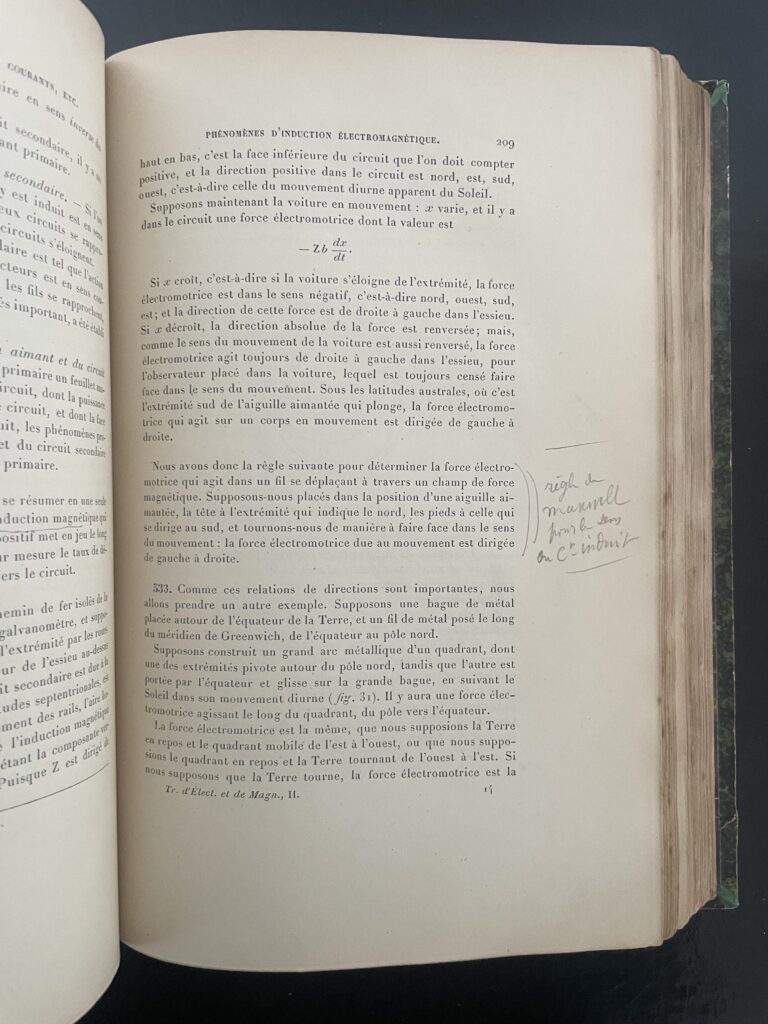
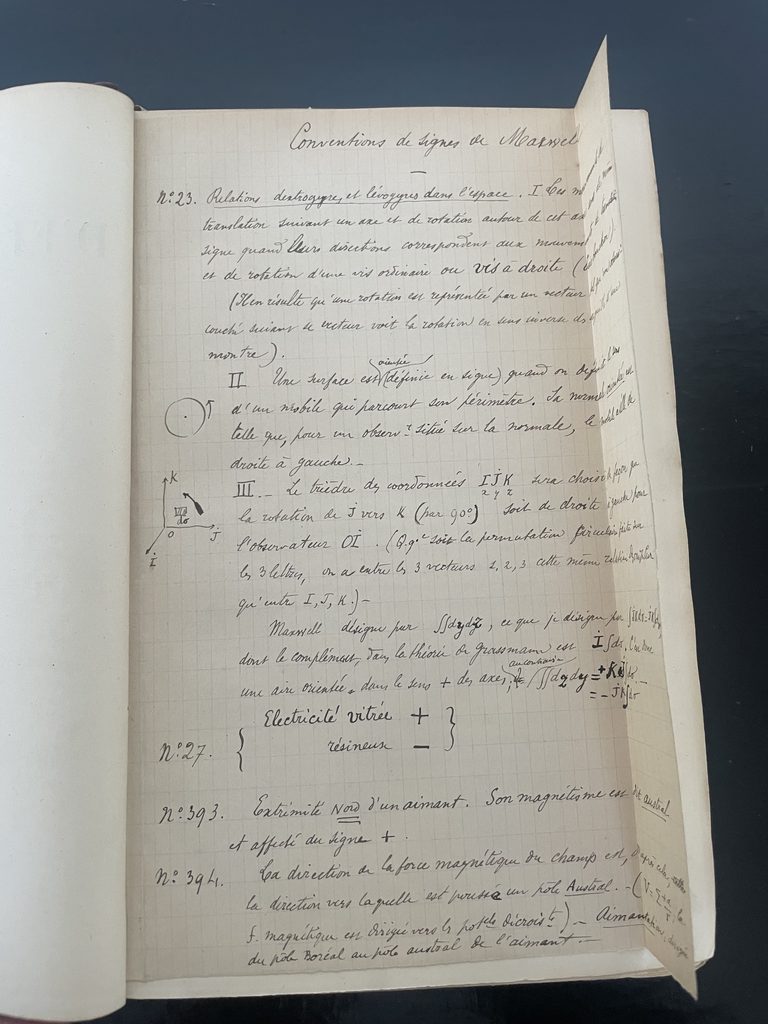
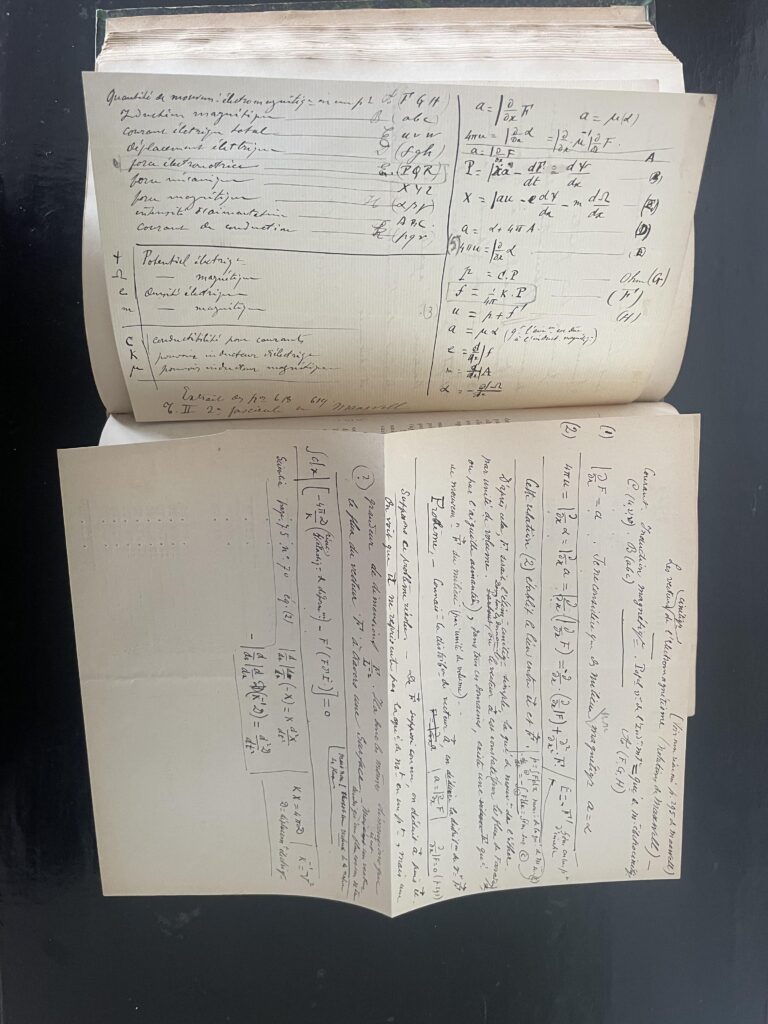
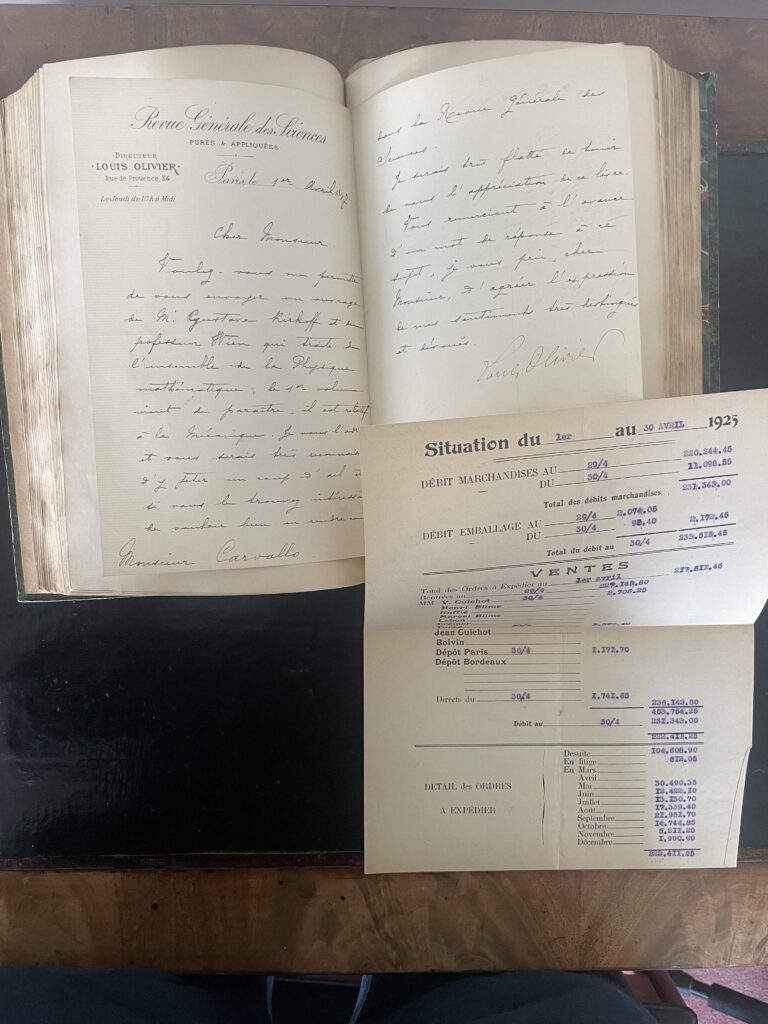
Throughout the volumes, Carvallo added manuscript notes in the margins and on separate sheets.
The result is not simply a copy of Maxwell’s text but evidence of a scientist actively working through Maxwell’s ideas.
For LUMEN, the annotations make the volumes particularly significant. They preserve the transition from the publication of a transformative theory to its study, interpretation and transmission by the next generation.
The Copy
James Clerk Maxwell
Traité d’électricité et de magnétisme
Paris: Gauthier-Villars, 1885–87.
First French edition. Two volumes.
This French translation appeared little more than a decade after the first edition of Maxwell’s Treatise and during the period in which electromagnetic theory was becoming increasingly influential in Continental physics.
The volumes retain their contemporary half-chagreen bindings and contain extensive manuscript annotations by Emmanuel Carvallo, primarily on the bound and inserted loose sheets but also in the margins.
A Scientific Life
Emmanuel Carvallo
The annotations provide the most distinctive element of the LUMEN copy.
Emmanuel Carvallo was active within French mathematical and physical science and belonged to both the Société mathématique de France and the Société française de physique. He taught electricity and later served as Director of Studies at the École Polytechnique from 1909 to 1920.
His annotations show Maxwell’s theory being treated not as a historical monument but as working science.
Calculations, comments and manuscript additions record the process by which a difficult new theoretical framework was read, interpreted and absorbed.
From Britain to France
Maxwell’s theory emerged from a distinctively British tradition shaped particularly by Faraday’s experimental conception of fields.
Its reception on the Continent required not simply translation of language, but engagement with a different mathematical and scientific culture.
The first French edition represents part of that process of transmission.
Carvallo’s annotations add another layer: Maxwell’s theory translated, read and worked through by a French physicist.
That makes these volumes particularly appropriate to one of LUMEN’s recurring themes: the movement of ideas between people, institutions, languages and generations.
Bibliographical Details
MAXWELL, James Clerk.
Traité d’électricité et de magnétisme.
Paris: Gauthier-Villars, 1885–87.
Edition: First French edition
Volumes: 2
Format: 8vo, approximately 250 × 164 mm
Pagination: Vol. I: xx, 578 pp.; Vol. II: [6], 651 pp.
Illustrations: One plate in each volume
Binding: Contemporary half chagreen, spines in five compartments
Condition: Very good; bindings sound with minor wear; contents clean and well preserved.
Annotations: Extensive manuscript marginalia and numerous notes on loose sheets by Emmanuel Carvallo
Provenance: Emmanuel Carvallo (1856–1945)
Publication: Paris, Gauthier-Villars, 1885–87
Gallery
Maxwell marks one of the great turning points in the history of light. Optics ceased to stand alone: light became one manifestation of the electromagnetic field.
Earlier Context
● Young— interference and wave behaviour
● Fresnel — wave optics
This Work
★ Maxwell — electromagnetic light
Later Developments
★ Hertz — experimental confirmation
● Einstein — light quanta
Related Galleries
Electricity and Electromagnetism
Matter and Energy
Space, Time and Gravitation
The Quantum Revolution
The Lives of Books
Atlas Connections
People
Maxwell · Faraday · Young · Fresnel · Hertz · Carvallo · Poincaré · Lorentz · Einstein
Ideas
Light · Electromagnetism · Field Theory · Wave Theory · Unification · Mathematical Physics · Scientific Transmission