The Bakerian Lecture: Experiments and Calculations Relative to Physical Optics · 1804
The Question
Can light travel as a wave?
For more than a century, Newton’s corpuscular account had dominated the study of light. Young challenged that consensus by showing that optical phenomena could be explained if light behaved as a wave.
Through the principle of interference, he provided a powerful new way of understanding the behaviour of light and reopened one of the great scientific debates in physics.
Why This Work Matters
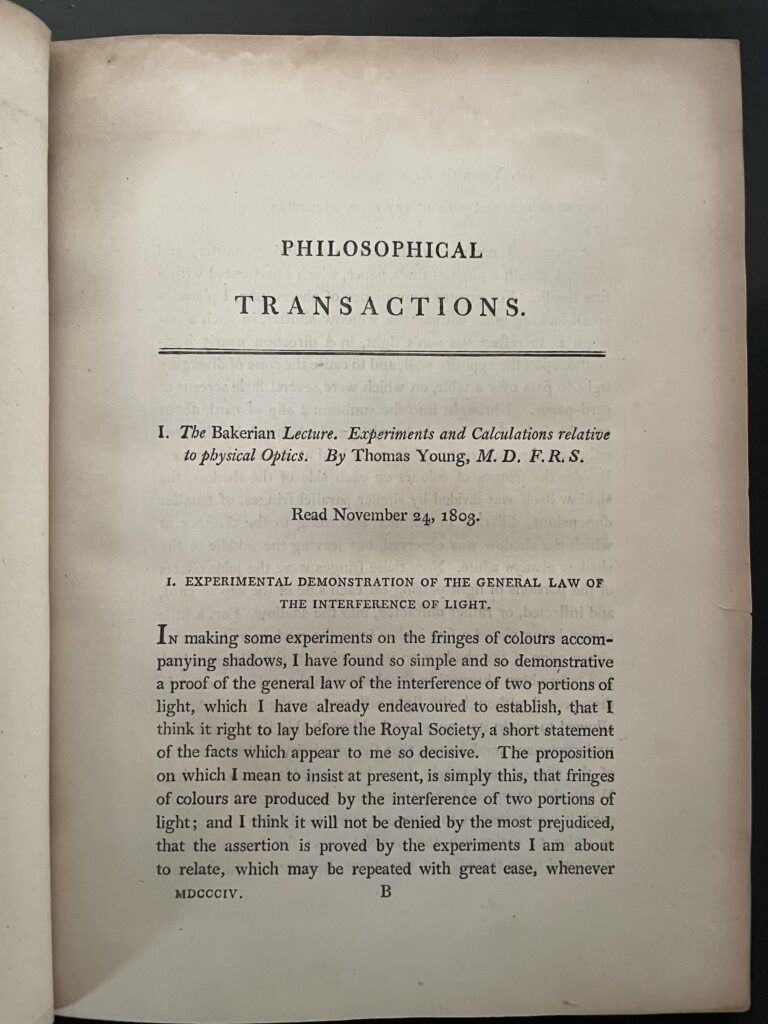
Young first set out the interference principle in his landmark 1802 work On the Theory of Light and Colours. In the 1804 Bakerian Lecture represented by the LUMEN copy, he developed the experimental and theoretical case for wave optics further. Published in the Philosophical Transactions of the Royal Society, it is one of the landmark papers in the history of optics.
Young argued that when waves of light overlap, they can reinforce or diminish one another. The principle of interference provided an explanation for patterns of brightness and darkness that were difficult to accommodate within a straightforward corpuscular account of light.
The implications were profound. Newton’s authority had helped establish corpuscular optics as the dominant framework of the eighteenth century. Young demonstrated that a wave conception could explain phenomena that this framework struggled to accommodate.
His work did not immediately settle the debate. Instead, it reopened it. Fresnel would subsequently develop wave optics into a much more powerful mathematical theory, while Maxwell would eventually identify light with electromagnetic waves.
Young therefore marks one of the decisive moments when an established scientific explanation was confronted by experimental evidence pointing towards a different conception of nature.
Place in the History of Ideas
Foundations
By the beginning of the nineteenth century, Newtonian optics had dominated scientific thinking about light for generations.
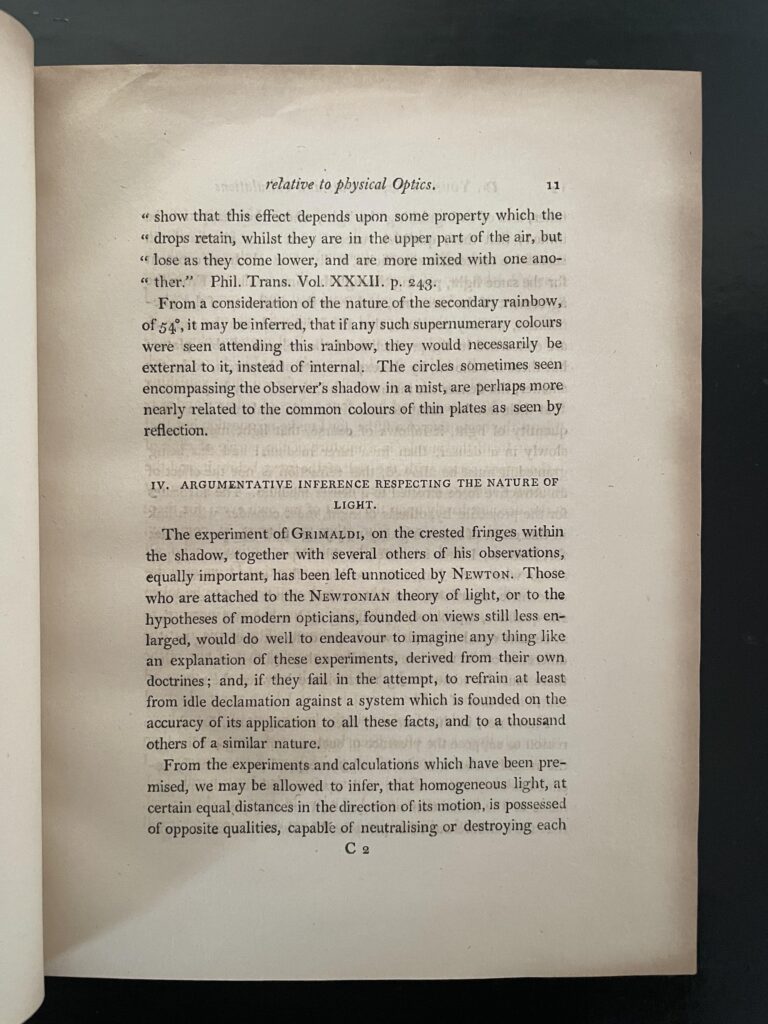
Grimaldi’s discovery of diffraction had nevertheless revealed behaviour that remained difficult to explain. Lambert and others had meanwhile made optical investigation increasingly quantitative.
There was also an alternative intellectual tradition. Christiaan Huygens had proposed a wave theory of light in the seventeenth century, but it had been overshadowed by the influence of Newtonian corpuscular optics.
The nature of light remained unresolved.
This Work
Thomas Young · The Bakerian Lecture · 1804
Young gave the wave conception of light powerful new experimental support.
His central principle was interference. When two light waves overlap, Young argued, their effects can reinforce one another to produce brightness or oppose one another to produce darkness.
This provided a coherent way of understanding optical phenomena that were difficult to reconcile with a simple particle model.
Young’s achievement was therefore not simply to revive an older wave hypothesis. He connected wave behaviour with observable experimental effects, providing a new foundation from which the physical theory of light could develop.
Immediate Legacy
Young’s ideas initially met substantial resistance, particularly in a scientific culture still strongly influenced by Newton.
The decisive development came through Augustin-Jean Fresnel, who combined experimental investigation with sophisticated mathematics to construct a much more complete theory of wave optics.
Interference and diffraction could now be understood within a common framework.
What Young had reopened as a scientific controversy became one of the central transformations of nineteenth-century physics.
Long-Term Influence
Young’s interference principle became fundamental to the science of light.
Fresnel developed its mathematical consequences. Maxwell subsequently showed that light could be understood as electromagnetic radiation, while Hertz demonstrated electromagnetic waves experimentally.
The arrival of quantum physics made the story more remarkable still. Interference remained unmistakable evidence of wave behaviour even as phenomena such as the photoelectric effect demanded a quantised description of light.
Young’s experiments therefore became part of a much deeper question that continues into modern physics: how can light display both wave-like and particle-like behaviour?
The Conversation
INHERITED
Grimaldi · Huygens · Newton · Lambert
Diffraction remained difficult to explain within the dominant corpuscular account, while an older wave conception of light had never entirely disappeared.
YOUNG · 1804
Interference provided powerful experimental evidence that light could behave as a wave.
PASSED ON
Fresnel · Maxwell · Hertz · Einstein
The wave theory grew into electromagnetic optics, before quantum physics transformed the question of light’s nature once again.
LUMEN Insight
Scientific progress sometimes begins by reopening a question that appeared to have been settled.
For more than a century, Newton’s account of light had shaped optical science. Young’s significance lay not simply in proposing an alternative, but in showing that experimental evidence could force even the most authoritative scientific explanations to be reconsidered.
Why this Copy Matters
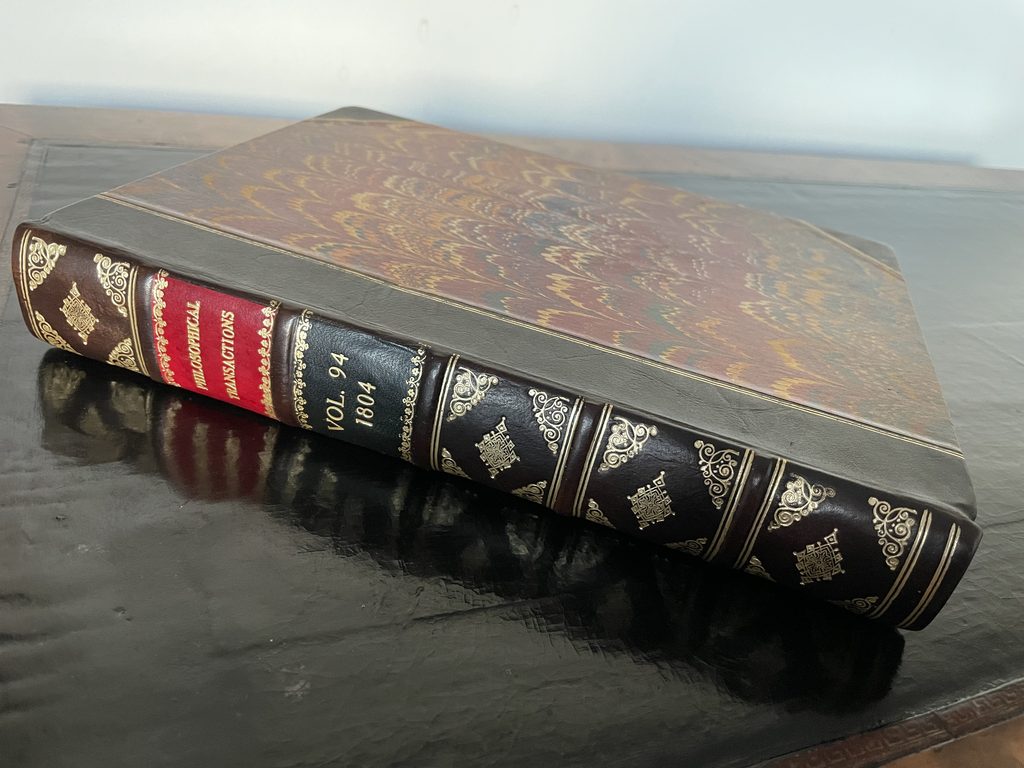
LUMEN’s copy preserves Young’s Bakerian Lecture in the complete 1804 volume of the Philosophical Transactions of the Royal Society of London, the journal in which his argument entered the scientific record.
Unlike several LUMEN volumes whose individual histories are enriched by exceptional provenance, the significance of this copy lies principally in the original publication of Young’s work within its contemporary scientific setting.
The surrounding volume contains papers by other leading scientific figures of the period, including Count Rumford and William Herschel. Young’s paper can therefore be encountered not as an isolated landmark extracted from its surroundings, but as part of the continuing scientific conversation conducted through the Royal Society.
The Copy
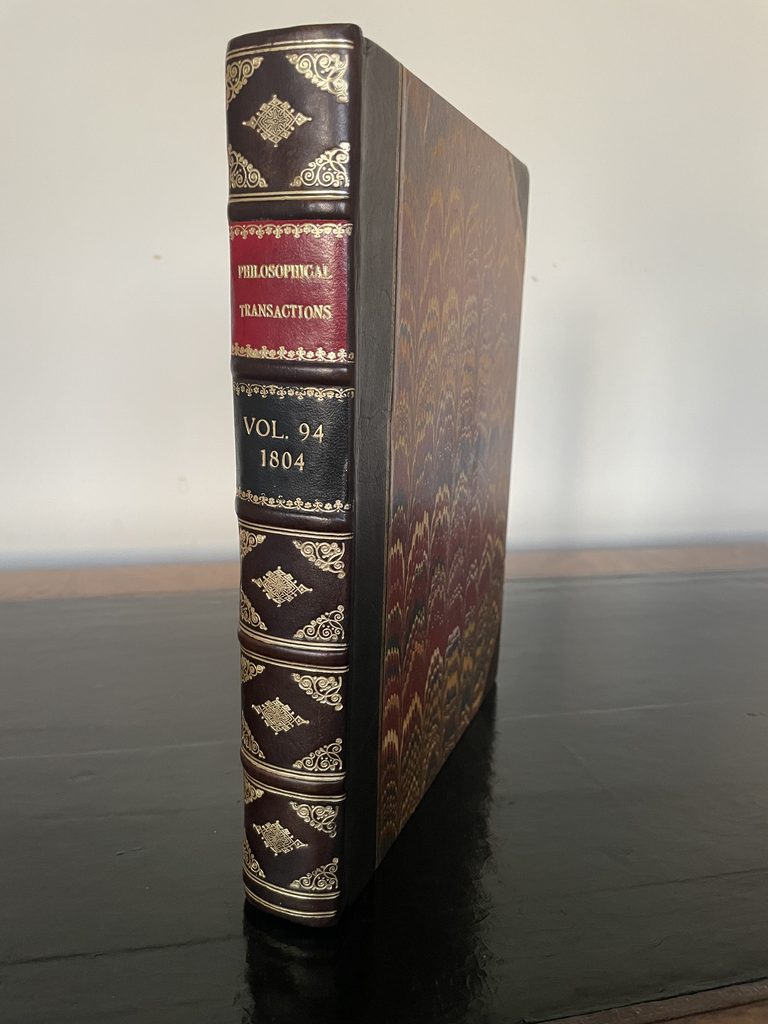
First edition. London: Royal Society, 1804. Quarto.
Young’s paper, The Bakerian Lecture: Experiments and Calculations Relative to Physical Optics, was published in volume 94 of the Philosophical Transactions of the Royal Society of London.
LUMEN’s copy comprises the complete volume, Parts I and II, extending to vi, 434 and 26 pages, with plates throughout.
The volume is internally fresh and complete and has been placed in a modern sympathetic calf-backed and calf-tipped binding, providing protection while retaining the appearance appropriate to an early nineteenth-century scientific journal.
Interference
At the heart of Young’s argument was the principle of interference.
Light arriving by different paths could reinforce or diminish itself, producing variations in brightness that followed naturally from wave behaviour. This transformed apparently troublesome optical effects into evidence for an alternative conception of light.
Young’s experimental descriptions made the phenomenon something that could be investigated, reproduced and ultimately developed mathematically by later physicists.
In the Scientific Record
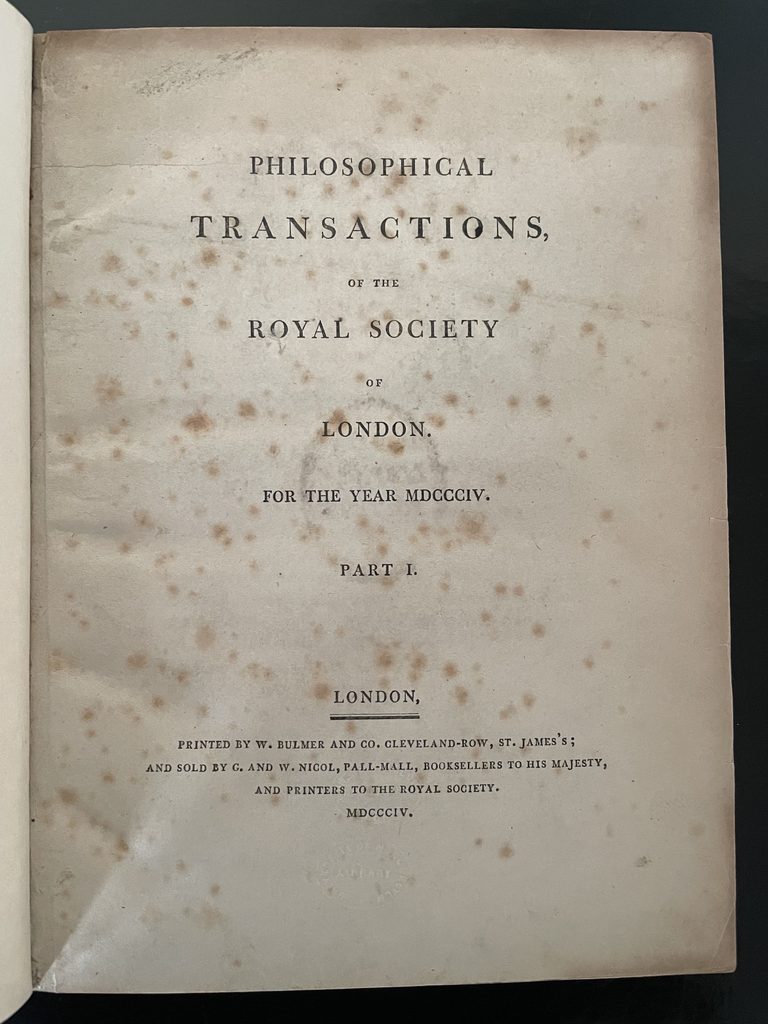
Young’s lecture appeared within the Philosophical Transactions, one of the principal channels through which scientific results had circulated since the seventeenth century.
Preserving the complete volume retains that original context. Young appears alongside the other investigations being presented to the Royal Society in 1804, allowing the paper to be seen as contemporaries first encountered it: one contribution to an active and continuing scientific conversation.
Bibliographical Details
YOUNG, Thomas.
“The Bakerian Lecture: Experiments and Calculations Relative to Physical Optics.”
In: Philosophical Transactions of the Royal Society of London, Vol. 94, Parts I & II. London: Royal Society, 1804.
Edition: First edition
Format: 4to; complete journal volume
Collation: vi, 434, 26 pp.
Illustration: Plates throughout the volume
Binding: Modern sympathetic calf-backed and calf-tipped boards
Condition: Very good; internally fresh and complete
Provenance: None noted
References: PMM 261; DSB; Norman 2313; Dibner, Heralds of Science
Gallery
Young represents the moment when the dominant understanding of light was fundamentally challenged. Interference returned wave behaviour to the centre of optical science and reopened a debate that would reshape nineteenth-century physics.
Earlier Context
● Newton — colour and corpuscular theory
○ Bouguer — early photometry
● Lambert — photometry
This Work
● Young — interference and wave behaviour
Later Developments
● Fresnel — mathematical wave optics
★ Maxwell — electromagnetic light
★ Hertz — experimental confirmation
Related Galleries
- The Scientific Method
- Matter and Energy
- The Quantum Revolution
Atlas Connections
People
Young · Grimaldi · Huygens · Newton · Fresnel · Maxwell · Hertz · Einstein
Ideas
Interference · Wave Theory · Diffraction · Experiment · Electromagnetic Light · Wave–Particle Duality