Untersuchungen über die Ausbreitung der elektrischen Kraft · 1892
First edition

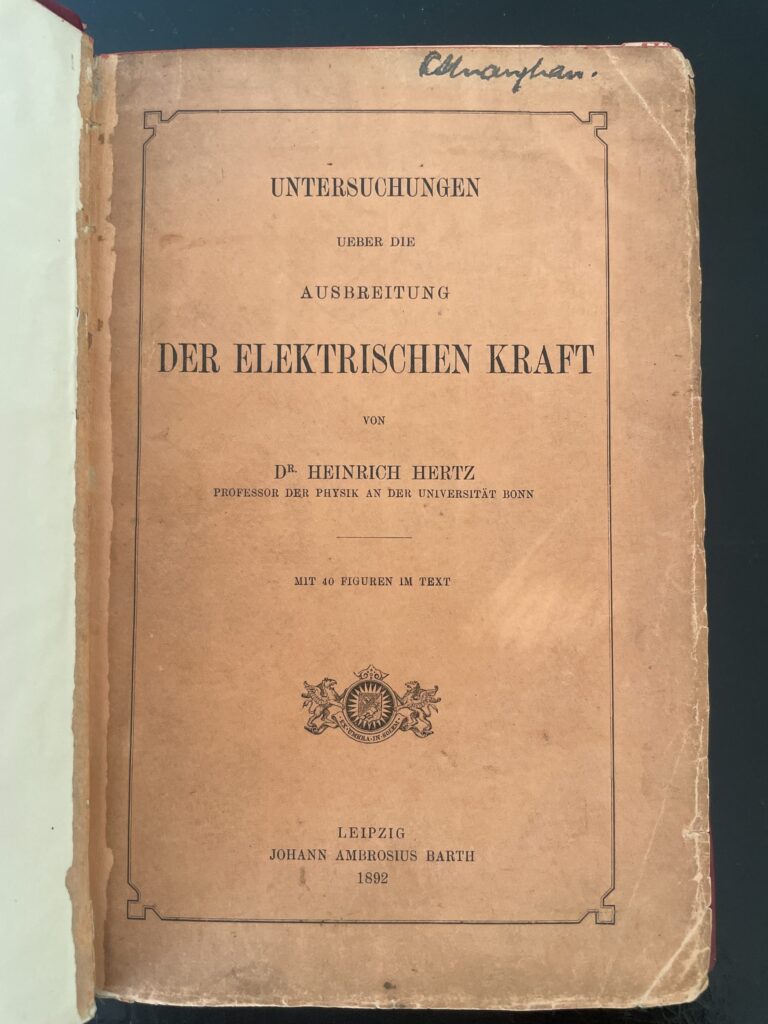

The Question
Can Maxwell’s theory be demonstrated experimentally?
James Clerk Maxwell had shown mathematically that light should be an electromagnetic wave. Heinrich Hertz put that prediction to the experimental test.
During the late 1880s, Hertz succeeded in generating and detecting electromagnetic waves in the laboratory. His experiments showed that they possessed properties familiar from light, providing powerful experimental confirmation of Maxwell’s theory.
The LUMEN collection preserves several stages in this story, including Hertz’s original journal papers of 1887 and 1888 and the first edition of his collected researches, published in 1892.
Why This Work Matters
Heinrich Hertz transformed one of the great theoretical predictions of nineteenth-century physics into experimental reality.
Maxwell’s theory of electromagnetism implied that changing electric and magnetic fields could propagate through space as waves. Their predicted velocity corresponded to the measured speed of light, leading Maxwell to identify light itself as an electromagnetic phenomenon.
But electromagnetic waves beyond visible light had never been deliberately generated and detected.
During the 1880s, Hertz devised a series of experiments using rapidly oscillating electrical discharges and simple resonant detectors. He succeeded in producing electromagnetic waves and investigating their behaviour in the laboratory.
He demonstrated phenomena characteristic of waves, including reflection and interference.
Maxwell’s mathematical prediction had become an observable physical phenomenon.
Place in the History of Ideas
Foundations
Young and Fresnel had established the wave theory of light. Faraday had transformed ideas about electricity and magnetism through his conception of fields.
Maxwell brought these traditions together mathematically.
His electromagnetic theory suggested something extraordinary: light was one manifestation of a much broader family of electromagnetic waves.
One crucial question remained: Did those predicted waves actually exist?
Hertz’s Experiments
Heinrich Hertz · Electromagnetic Waves · 1887–88
Hertz answered the question experimentally.
Beginning with investigations of extremely rapid electrical oscillations, he developed methods for producing and detecting electromagnetic disturbances.
His experiments produced a remarkable series of papers during 1887 and 1888. Hertz investigated how electromagnetic effects propagated and demonstrated electromagnetic waves travelling through space and undergoing reflection.
The experiments provided compelling confirmation of Maxwell’s electromagnetic theory.
The physics of light had become inseparable from the physics of electricity and magnetism.
Immediate Legacy
Hertz’s experiments rapidly attracted the attention of physicists across Europe.
Researchers including Oliver Lodge explored electromagnetic waves further, while Guglielmo Marconi and others recognised that the new phenomena could be used for wireless communication.
Hertz himself died in 1894, aged only thirty-six, before many of these technological consequences emerged.
Long-Term Influence
The consequences eventually encompassed radio, broadcasting, telecommunications, radar and much of the electromagnetic technology of the modern world.
Yet Hertz’s experiments also contained clues to another revolution.
While investigating electrical sparks in 1887, he observed that ultraviolet light affected electrical discharge. The phenomenon would later form part of the experimental background to the photoelectric effect.
In 1905, Einstein’s explanation of that effect using light quanta revealed that Maxwell’s electromagnetic wave description of light, powerful though it was, was not the whole story.
The Conversation
INHERITED
Young · Fresnel · Maxwell
HERTZ · 1887–88
PASSED ON
Einstein
LUMEN Insight
The most powerful scientific theories can predict phenomena that have never yet been observed.
Maxwell’s mathematics implied the existence of electromagnetic waves. Hertz devised experiments that made them observable.
The passage from Maxwell to Hertz is one of the clearest demonstrations of the continuing conversation between theory and experiment.
Why This Copy Matters
LUMEN preserves an unusually broad record of Hertz’s experimental programme.
The principal exhibit is the first edition of Untersuchungen über die Ausbreitung der elektrischen Kraft, published in Leipzig in 1892, in which Hertz’s investigations of electromagnetic phenomena were brought together as a coherent body of research.
The copy retains its original wrappers and contains a signed letter from Sir Robert Watson-Watt, dated 12 October 1968, discussing Hertz as an important inspiration for the later development of radio, direction finding and radar.
But the story begins earlier.
LUMEN also preserves complete contemporary volumes of Annalen der Physik und Chemie containing Hertz’s original papers from 1887 and 1888, together with a separate sammelband assembling thirteen of his papers.
Together, the objects allow Hertz’s work to be followed from individual experimental reports, through consolidation into a scientific programme, to technological consequences many decades later.
The Original Experiments
1887
The 1887 volume of Annalen der Physik und Chemie contains three papers by Hertz, including Ueber sehr schnelle electrische Schwingungen, in which he investigated very rapid electrical oscillations.
These experiments formed part of the developing programme that would lead Hertz towards the generation and detection of electromagnetic waves.
An Unexpected Discovery
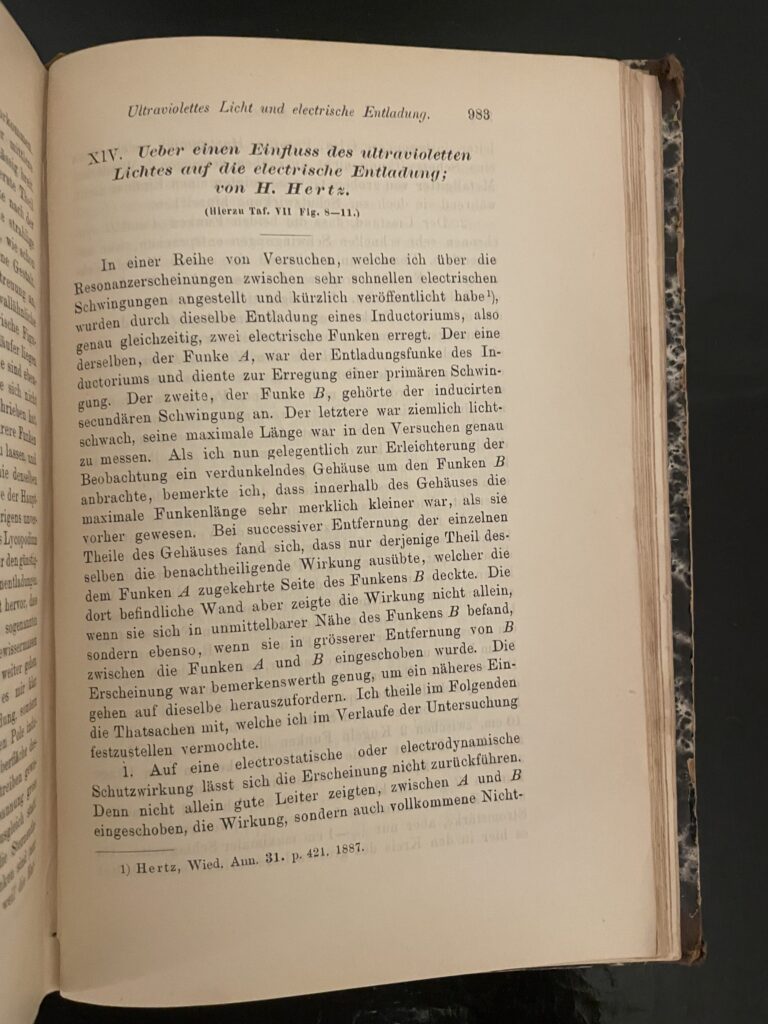
The same volume contains Ueber einen Einfluss des ultravioletten Lichtes auf die electrische Entladung, recording an unexpected observation made during Hertz’s electrical experiments.
Hertz noticed that ultraviolet light made electrical discharge across a spark gap easier. At the time, the phenomenon was an intriguing experimental effect whose deeper significance was not yet understood.
Later investigations developed this phenomenon into what became known as the photoelectric effect. Einstein’s explanation of the effect in 1905 using light quanta became one of the foundations of quantum physics.
There is a striking historical symmetry. Hertz’s experiments would provide powerful evidence for Maxwell’s electromagnetic wave theory of light, while another phenomenon encountered during the same experimental programme would eventually contribute to the quantum theory of light.
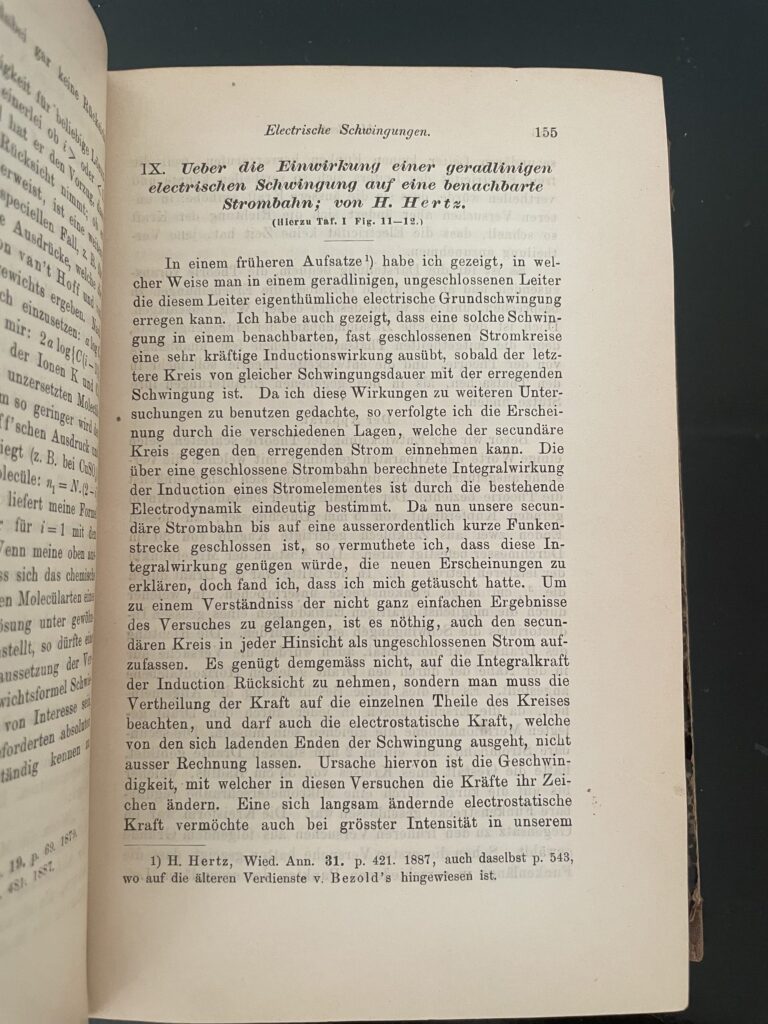
An unexpected observation. Hertz’s 1887 paper on the influence of ultraviolet light on electrical discharge, part of the experimental history that would eventually lead to the photoelectric effect.
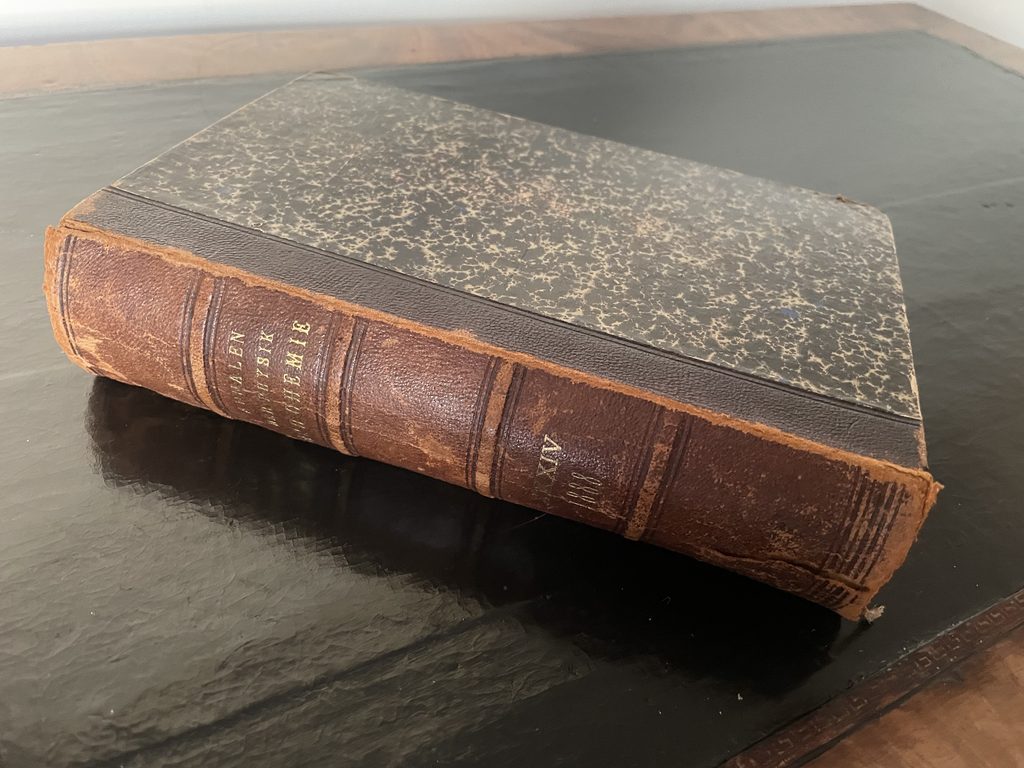
1888
The following year’s volume preserves four further Hertz papers from the decisive period of his electromagnetic-wave experiments.
Among them are Ueber die Ausbreitungsgeschwindigkeit der electrodynamischen Wirkungen and Ueber electrodynamische Wellen im Luftraume und deren Reflexion.
Here Hertz investigated the propagation of electromagnetic effects and demonstrated electromagnetic waves travelling through free space and undergoing reflection. These experiments provided compelling physical evidence for the electromagnetic world predicted by Maxwell.
Original Journal Publication
Original journal publication of Hertz’s experiments with electromagnetic waves.
Annalen der Physik und Chemie, 1888.
From Papers to a Scientific Programme
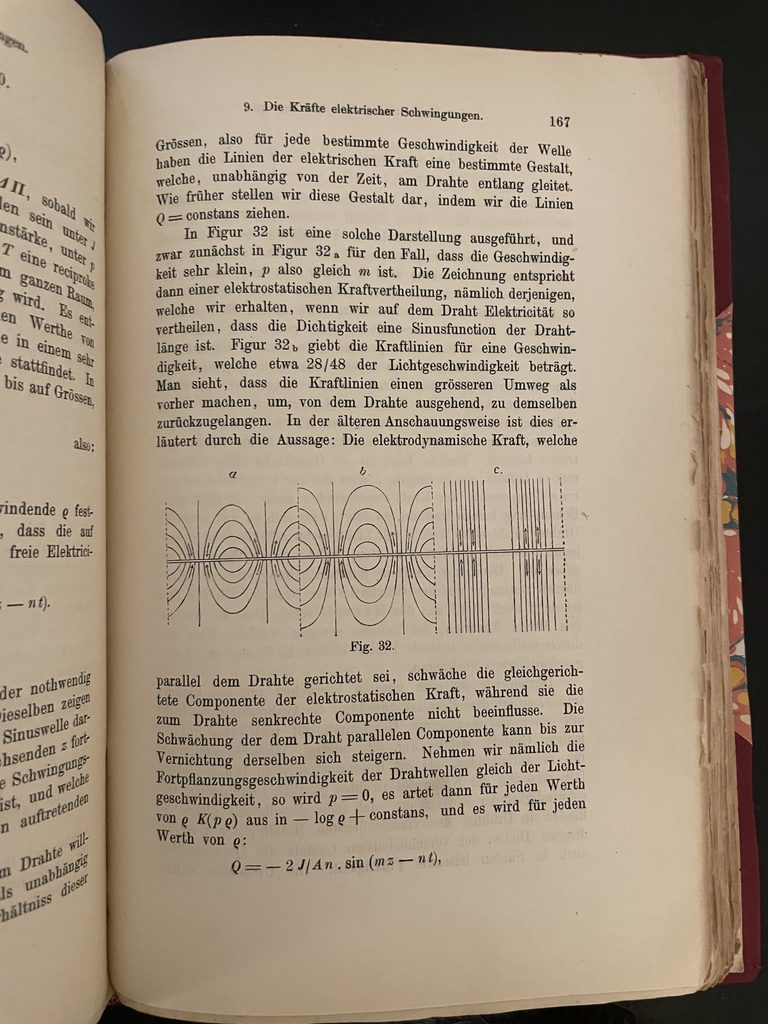
In 1892, Hertz’s researches were brought together in Untersuchungen über die Ausbreitung der elektrischen Kraft.
Seen alongside the original journal volumes, the book represents a different stage in the life of the science.
The Annalen volumes show experiments appearing individually as Hertz’s investigations developed. The Untersuchungen presents the work retrospectively as a connected programme of research.
LUMEN therefore preserves both the emergence and the consolidation of Hertz’s experimental achievement.

From Experiment to Radar
The story represented by the LUMEN copy extends far beyond Hertz’s lifetime.
Tipped into the 1892 volume is a signed letter from Sir Robert Watson-Watt, dated 12 October 1968.
Watson-Watt became one of the central figures in the development of radio direction finding and radar. His letter reflects upon Hertz as an important inspiration for the technologies that ultimately grew from electromagnetic research.
The association creates an unusually direct connection across generations:
Maxwell predicted → Hertz demonstrated → Watson-Watt applied
Hertz performed his experiments to investigate fundamental physics. Their technological consequences would transform the following century.

Hertz in LUMEN
1887 · Annalen der Physik und Chemie, Band 31
Three Hertz papers, including rapid electrical oscillations and the ultraviolet effect on electrical discharge.
1888 · Annalen der Physik und Chemie, Band 34
Four Hertz papers from the crucial electromagnetic-wave experiments.
1887–92 Sammelband
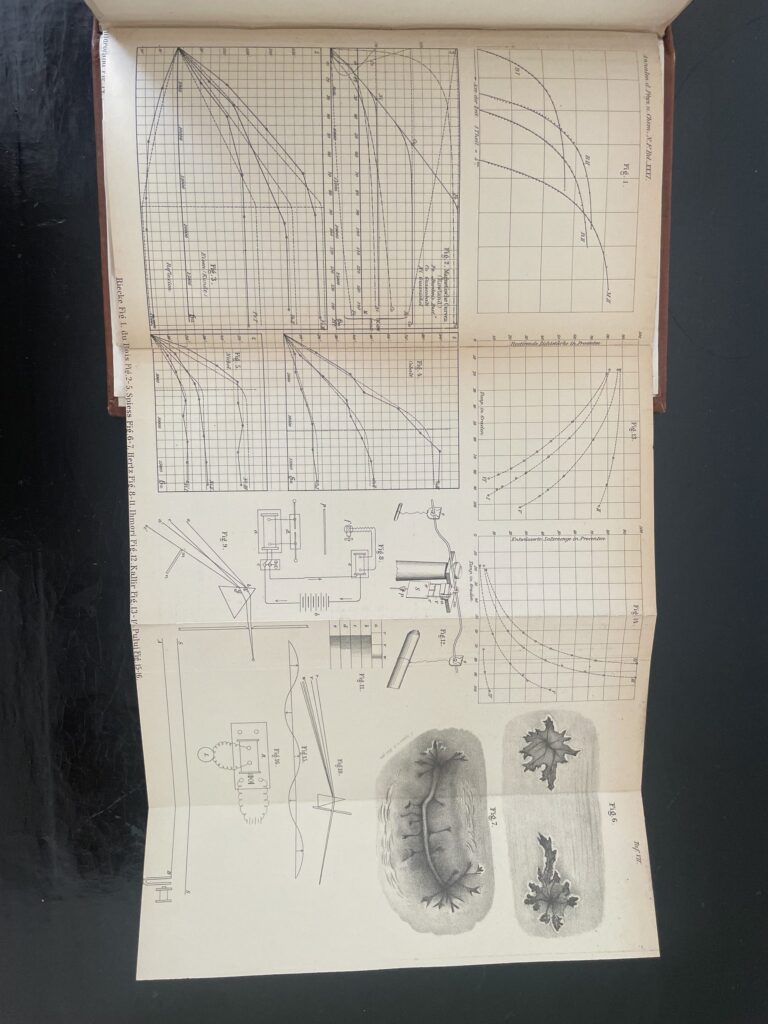
Thirteen papers tracing Hertz’s developing research programme, largely extracted from contemporary journal publications
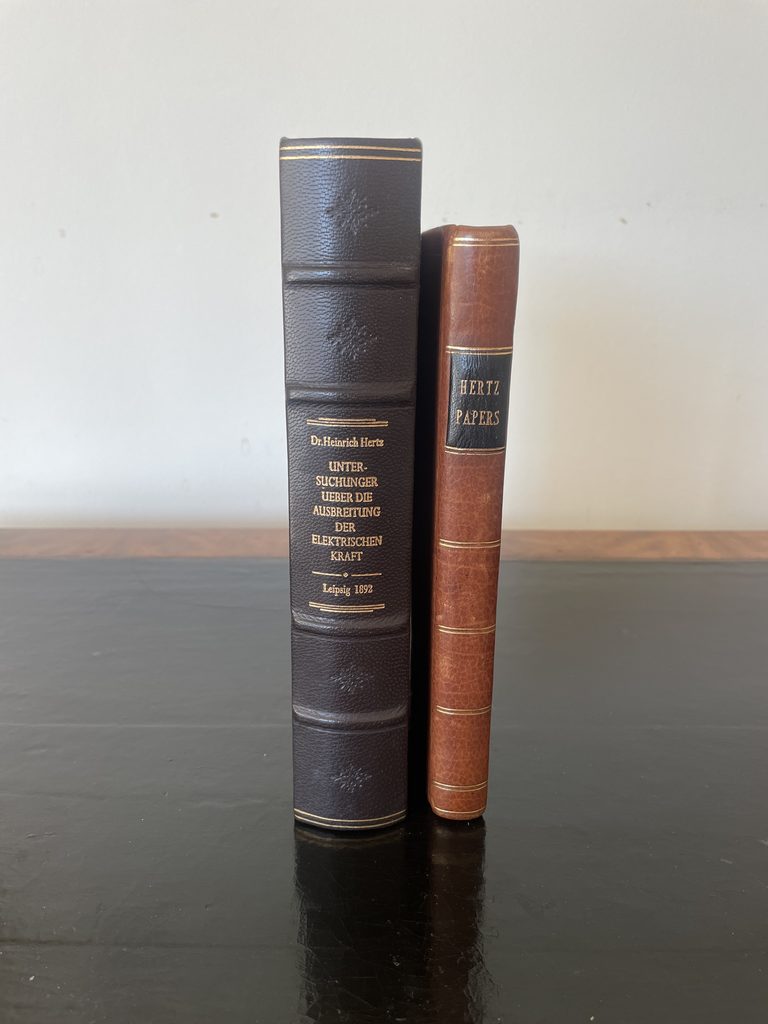
1892 · Untersuchungen über die Ausbreitung der elektrischen Kraft
First edition of Hertz’s collected experimental researches, with the Watson-Watt letter.
Bibliographical Details
1887 · Original Journal Papers
HERTZ, Heinrich.
“Ueber sehr schnelle electrische Schwingungen”; “Nachtrag zu der Abhandlung über sehr schnelle electrische Schwingungen”; and “Ueber einen Einfluss des ultravioletten Lichtes auf die electrische Entladung.”
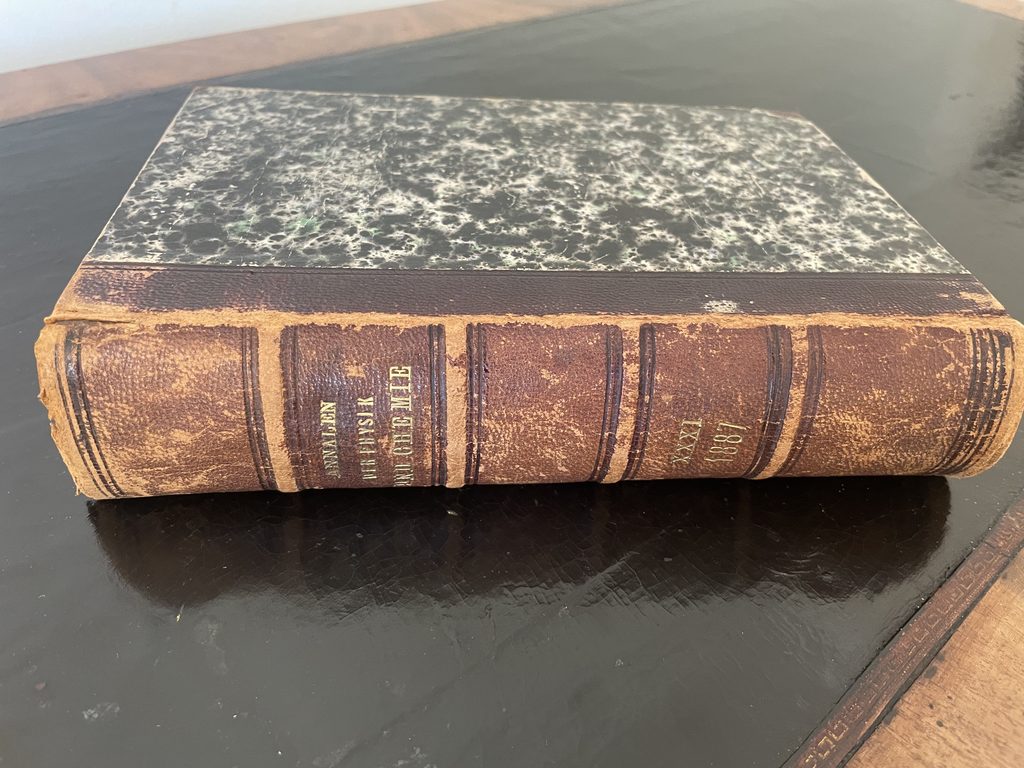
In Annalen der Physik und Chemie, Neue Folge, Band XXXI. Leipzig: Johann Ambrosius Barth, 1887.
Edition: First editions
Format: 8vo, approx. 215 × 145 mm
Pagination: viii, 1048 pp.
Illustrations: Eight plates in the complete volume
Binding: Contemporary quarter chagreen over marbled boards
Condition: Binding rubbed with wear to spine and extremities; contents well preserved
Other Significant Contents: Papers by Ludwig Boltzmann and Max Planck
1888 · Electromagnetic-Wave Experiments
HERTZ, Heinrich.
“Ueber die Einwirkung einer geradlinigen Schwingung auf eine benachbarte Strombahn”; “Ueber Inductionserscheinungen, hervorgerufen durch die electrischen Vorgänge in Isolatoren”; “Ueber die Ausbreitungsgeschwindigkeit der electrodynamischen Wirkungen”; and “Ueber electrodynamische Wellen im Luftraume und deren Reflexion.”
In Annalen der Physik und Chemie, Neue Folge, Band XXXIV. Leipzig: Johann Ambrosius Barth, 1888.
Edition: First editions
Format: 8vo, approx. 215 × 145 mm
Pagination: viii, 1048 pp.; Hertz papers at pp. 155–170, 273–285, 551–569 and 609–623
Illustrations: Eight plates in the complete volume
Binding: Contemporary quarter chagreen over marbled boards
Condition: Binding rubbed with substantial wear to spine and extremities; contents well preserved
1887–92 · Thirteen-Paper Sammelband
HERTZ, Heinrich.
A collection of thirteen papers on electromagnetic phenomena.
Largely extracted from Annalen der Physik und Chemie. [Leipzig], 1887–92.
Edition: First journal printings, collected together
Format: 8vo
Illustrations: Seven folding engraved plates
Binding: Twentieth-century calf with navy morocco spine label; housed in a morocco-backed drop-back box
Condition: Toning and light surface soiling; final three pages torn and repaired at inner margins without loss of text
Hertz Papers:
Ueber sehr schnelle electrische Schwingungen;
Nachtrag zu der Abhandlung über sehr schnelle electrische Schwingungen;
Ueber einen Einfluss des ultravioletten Lichtes auf die electrische Entladung;
Ueber die Einwirkung einer geradlinigen electrischen Schwingung auf eine benachbarte Strombahn;
Ueber Inductionserscheinungen, hervorgerufen durch die electrischen Vorgänge in Isolatoren;
Ueber electrodynamische Wellen im Luftraume und deren Reflexion;
Die Kräfte electrischer Schwingungen, behandelt nach der Maxwell’schen Theorie;
Ueber Strahlen electrischer Kraft;
Ueber die Fortleitung electrischer Wellen durch Drähte;
Ueber die Grundgleichungen der Electrodynamik für ruhende Körper;
Ueber die Grundgleichungen der Electrodynamik für bewegte Körper;
Ueber die mechanischen Wirkungen electrischer Drahtwellen;
Ueber den Durchgang der Kathodenstrahlen durch dünne Metallschichten.
Other Significant Contents: Papers by Wilhelm Conrad Röntgen, Josef Stefan, Richard Nahrwold, Ernst Dorn, Ignaz Klemencic and others.
1892 · Collected Investigations
HERTZ, Heinrich.
Untersuchungen über die Ausbreitung der elektrischen Kraft.
Leipzig: Johann Ambrosius Barth, 1892.
Edition: First edition
Language: German
Format: 8vo
Pagination: vi, [2], 295, [1] pp.
Illustrations: Illustrations and diagrams in the text
Binding: Modern half morocco over marbled boards, with the original printed wrappers retained
Condition: Very good; complete
Provenance: Earlier ownership signatures to wrapper and title page
Association: Sir Robert Watson-Watt (1892–1973)
Letter: Signed letter from Watson-Watt, dated 12 October 1968, tipped in; discussing Hertz as an important inspiration for the subsequent development of radio, direction finding and radar
Gallery
Hertz marks the point at which Maxwell’s electromagnetic theory became experimentally observable. The wave properties previously associated with light could now be demonstrated in electromagnetic radiation generated in the laboratory.
Earlier Context
● Young — interference and wave behaviour
● Fresnel — mathematical wave optics
★ Maxwell — electromagnetic light
This Work
★ Hertz — experimental confirmation
Later Developments
● Einstein — light quanta
Related Galleries
Electricity and Electromagnetism
Matter and Energy
The Scientific Method
The Quantum Revolution
The Lives of Books
Atlas Connections
People
Hertz · Maxwell · Faraday · Young · Fresnel · Helmholtz · Einstein · Lodge · Marconi · Watson-Watt
Ideas
Electromagnetic Waves · Light · Experiment · Electromagnetism · Field Theory · Wave Propagation · Reflection · Interference · Photoelectric Effect · Radio · Radar · Scientific Transmission