Photometria sive de mensura et gradibus luminis, colorum et umbrae · 1760
The Question
How can light be measured?
Newton had transformed understanding of the composition and behaviour of light. Lambert addressed a different problem: could light itself be measured with mathematical precision?
In Photometria, Lambert brought experiment, geometry and calculation together to establish a systematic science of illumination. Light was no longer merely something to observe or explain. Its intensity, transmission and appearance could be compared, quantified and expressed through mathematical laws.
Why This Work Matters
Published in 1760, Photometria is a foundational work of mathematical photometry: the quantitative study of visible light.
Lambert investigated relationships between the strength of a light source, its distance from an illuminated surface, the angle at which light falls and the brightness perceived by an observer. Bringing experimental observation together with mathematical analysis, he established a systematic framework for comparing illumination.
Among the principles developed in the work is Lambert’s cosine law, describing the behaviour of an ideally diffuse surface with changing angle. The concept of a Lambertian surface remains fundamental in optics, imaging and computer graphics.
Photometria therefore marks an important change in the history of optics. Earlier investigators had asked how light travelled, what it was and how it produced colour. Lambert demonstrated that light could also become an object of precise quantitative measurement.
Place in the History of Ideas
Foundations
By the middle of the eighteenth century, optics had been transformed by experiment.
Grimaldi had revealed diffraction. Newton had demonstrated the composition of white light and made experimental optics one of the defining sciences of the Scientific Revolution. Other investigators, particularly Pierre Bouguer, had begun developing methods for comparing the intensity of light.
Yet a comprehensive mathematical science of illumination had not emerged.
This Work
Johann Heinrich Lambert · Photometria · 1760
Lambert sought to make light measurable.
He investigated how illumination changes with distance, how light is absorbed as it passes through materials, and how the angle of illumination and observation affects the apparent brightness of a surface.
The result was a mathematical framework in which properties of light that had often been judged through perception could instead be compared experimentally and expressed through quantitative relationships.
With Photometria, measurement itself became an important part of the science of light.
Immediate Legacy
Lambert helped establish the foundations upon which later photometry developed.
During the nineteenth century, increasingly sophisticated methods of measuring luminous intensity and illumination accompanied the rapid development of experimental optics. Quantitative observation became progressively more important as physicists investigated interference, diffraction, spectra and the relationship between light and other physical phenomena.
Measurement was becoming inseparable from theory.
Long-Term Influence
The principles developed in Photometria extend far beyond eighteenth-century optics.
Lambert’s treatment of illumination contributed to the development of modern photometry and radiometry, while concepts associated with his work remain important in astronomy, photography, optical engineering, remote sensing and computer graphics.
The continuing use of the term Lambertian is an unusually direct survival of an eighteenth-century investigation within modern scientific and technical language.
The Conversation
INHERITED
Grimaldi · Newton · Bouguer
Experiment had transformed the study of light, while the first methods for comparing illumination had begun to emerge.
LAMBERT · 1760
Light became a quantity that could be compared, calculated and expressed through mathematical laws.
PASSED ON
Young · Fresnel · Maxwell · Modern Photometry
Increasingly precise measurement became inseparable from the experimental investigation of light.
LUMEN Insight
Science changes when qualities become quantities.
Brightness appears at first to be a matter of human perception: one light simply looks brighter than another. Lambert showed how such observations could be subjected to controlled comparison and mathematical analysis. Photometria exemplifies a recurring transformation in science: turning what can be perceived into something that can be measured.
Why this Copy Matters
LUMEN’s copy is the first edition of Photometria, published at Augsburg in 1760, preserving the work in which Lambert established his systematic mathematical treatment of illumination.
Unlike some LUMEN volumes whose significance is amplified by exceptional scientific provenance or extensive annotation, the importance of this copy lies principally in the work and edition themselves. It represents a cornerstone in the development of quantitative optics at precisely the point in the gallery where measurement enters the story.
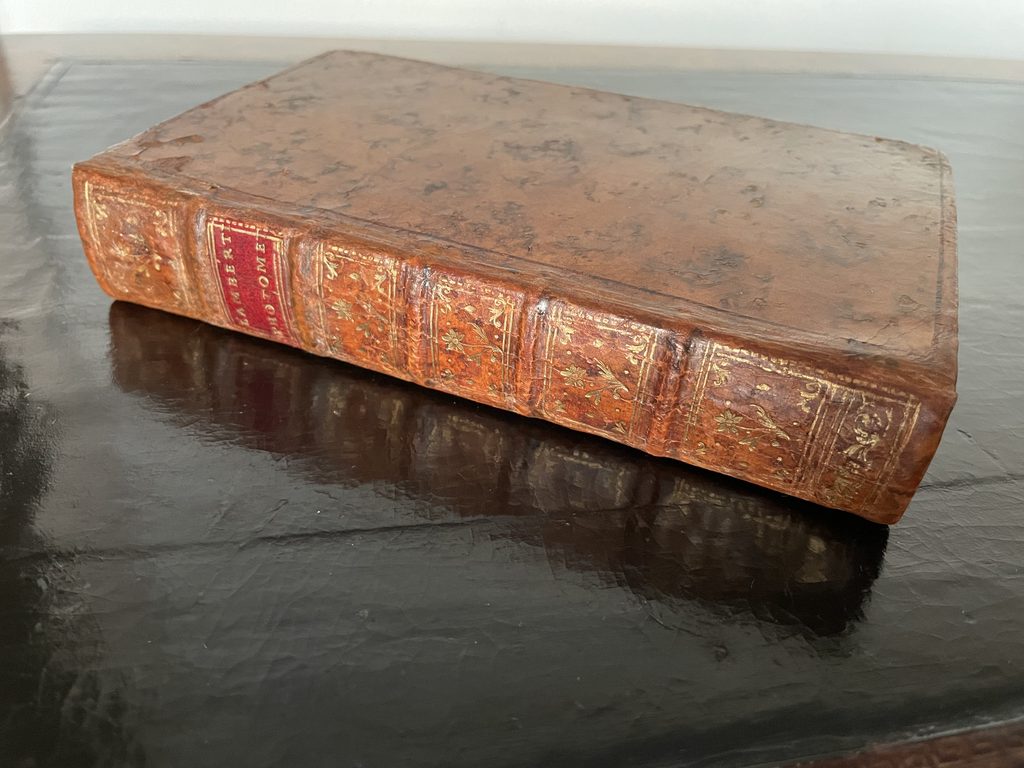
The volume also retains its contemporary mottled calf binding, allowing the physical object to remain recognisably of the period in which Lambert’s ideas first appeared.
The Copy
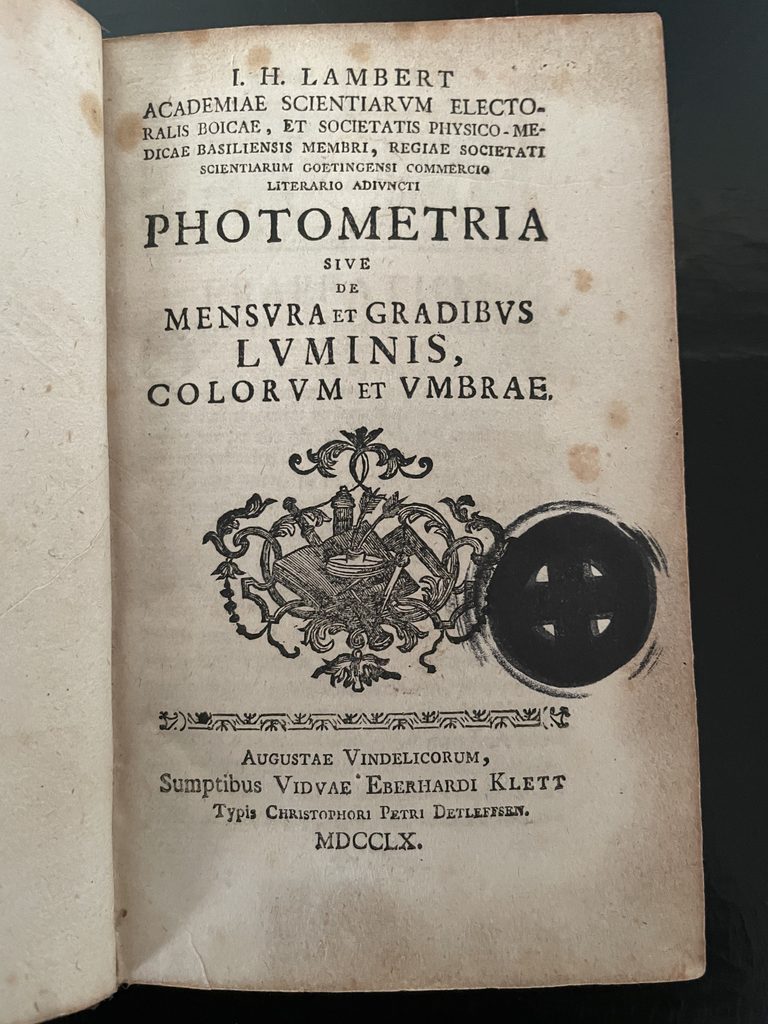
First edition. Augsburg: Christoph Peter Detleffsen for the widow of Eberhard Klett, 1760. Octavo.
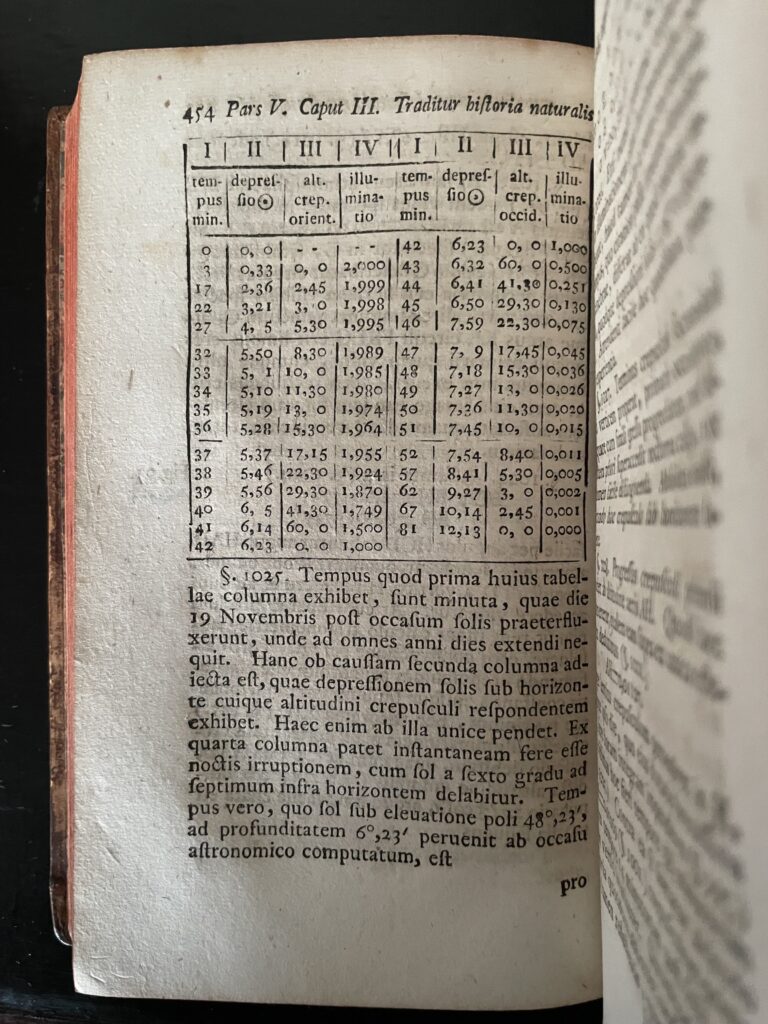
The volume contains eight folding engraved plates, illustrating the geometrical and mathematical relationships through which Lambert investigated light and illumination.
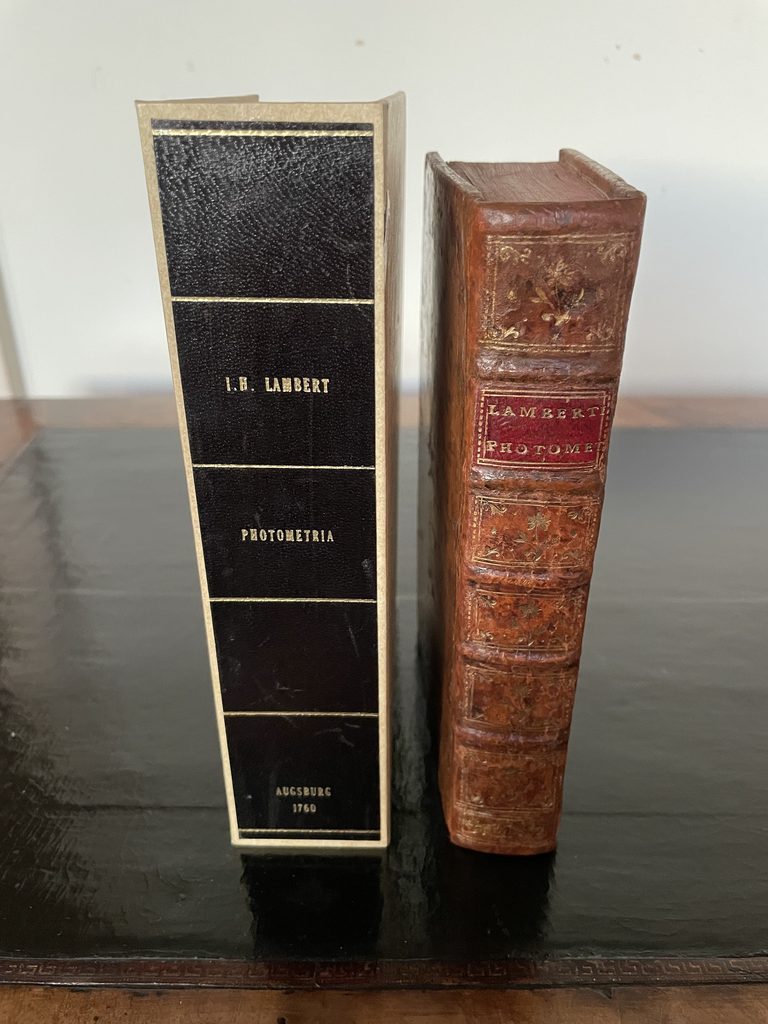
It survives in contemporary mottled calf, with a gilt spine divided into compartments and a red morocco label. The binding has undergone some expert restoration to the spine and corners and the volume is now protected in a drop-back box.
A former library stamp on the title page has been heavily inked out. The volume also carries the bookplate of Peter and Margarethe Braune.
The Mathematics of Light
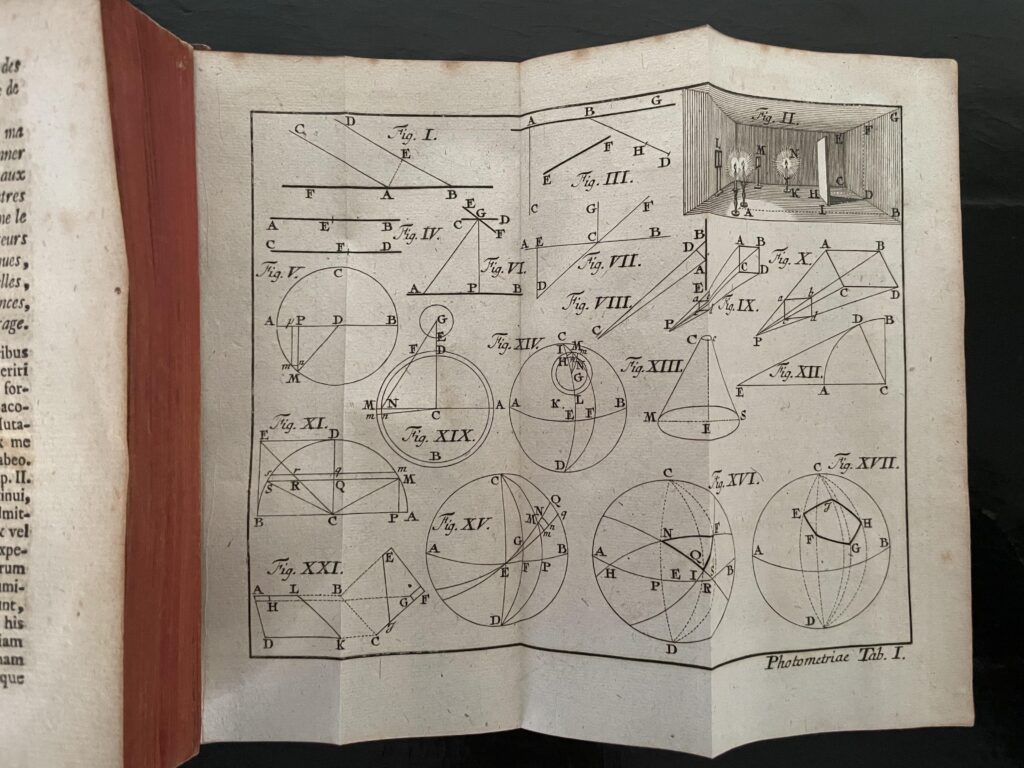
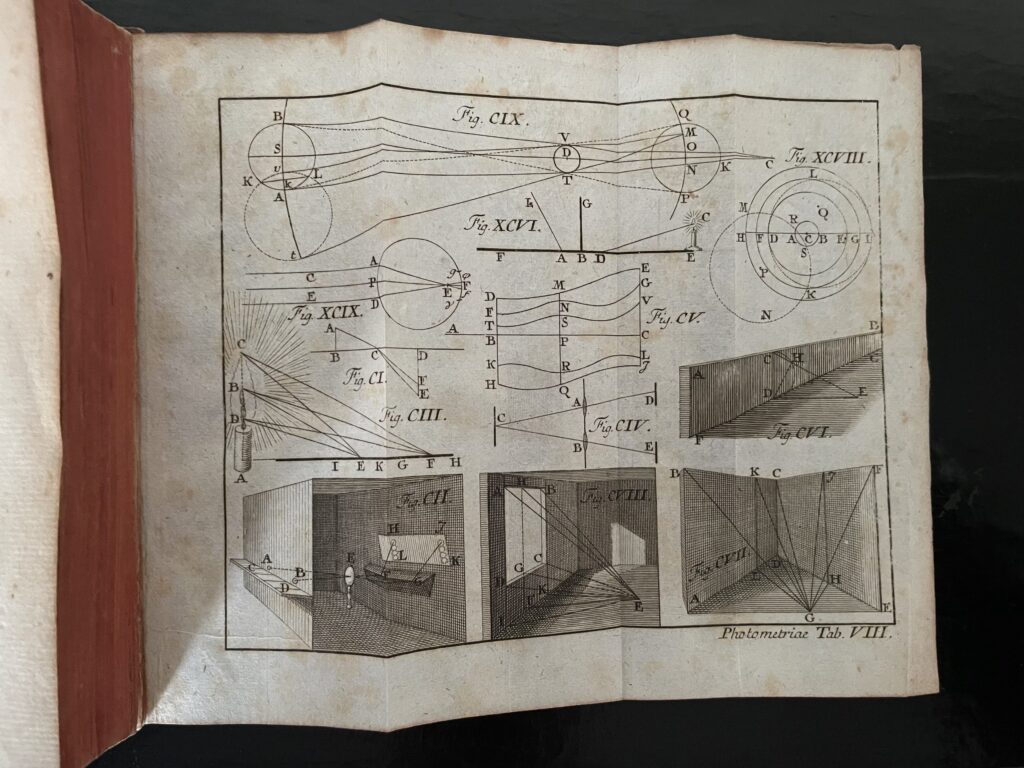
Lambert’s diagrams make visible one of the central ambitions of Photometria: to translate the behaviour of light into geometry and mathematics.
Relationships between source, surface, angle and observer could be represented spatially and subjected to calculation. The plates therefore form part of the argument of the book itself, showing how illumination could be transformed from a perceptual phenomenon into a mathematical object.
Bibliographical Details
LAMBERT, Johann Heinrich.
Photometria sive de mensura et gradibus luminis, colorum et umbrae.
Augsburg: Christoph Peter Detleffsen for the widow of Eberhard Klett, 1760.
Edition: First edition
Format: 8vo
Illustration: 8 folding engraved plates
Binding: Contemporary mottled calf; spine gilt in compartments with red morocco label; expert restoration to spine and corners
Condition: Some foxing and light browning; small hole to D6–8 with loss of a few letters; several short tears at head of E1 without loss of text
Copy Notes: Library stamp on title heavily inked out on recto and verso; housed in a drop-back box
Provenance: Peter and Margarethe Braune, bookplate
References: Grolier/Horblit 62; Norman 1269; PMM 205; Hulliger, “Johann Heinrich Lambert,” Bulletin of the Swiss Statistical Society 14 (2003), pp. 4–10
Gallery
Lambert introduces measurement into LUMEN’s history of light. Earlier works sought principally to describe or explain optical phenomena; Photometria demonstrates the emergence of light as something that could be systematically quantified.
Earlier Context
★ Grimaldi — diffraction
● Newton — colour and corpuscular theory
○ Bouguer — early photometry
This Work
● Lambert — photometry
Later Developments
● Young — interference
● Fresnel — wave optics
★ Maxwell — electromagnetic light
Related Galleries
- The Language of Mathematics
- The Scientific Method
- Matter and Energy
Atlas Connections
People
Lambert · Newton · Bouguer · Young · Fresnel · Maxwell
Ideas
Photometry · Measurement · Illumination · Geometry · Quantification · Mathematical Physics